Balkan Road Trip: Six Borders, One eSIM, Not a Single SIM Swap
 7 min read
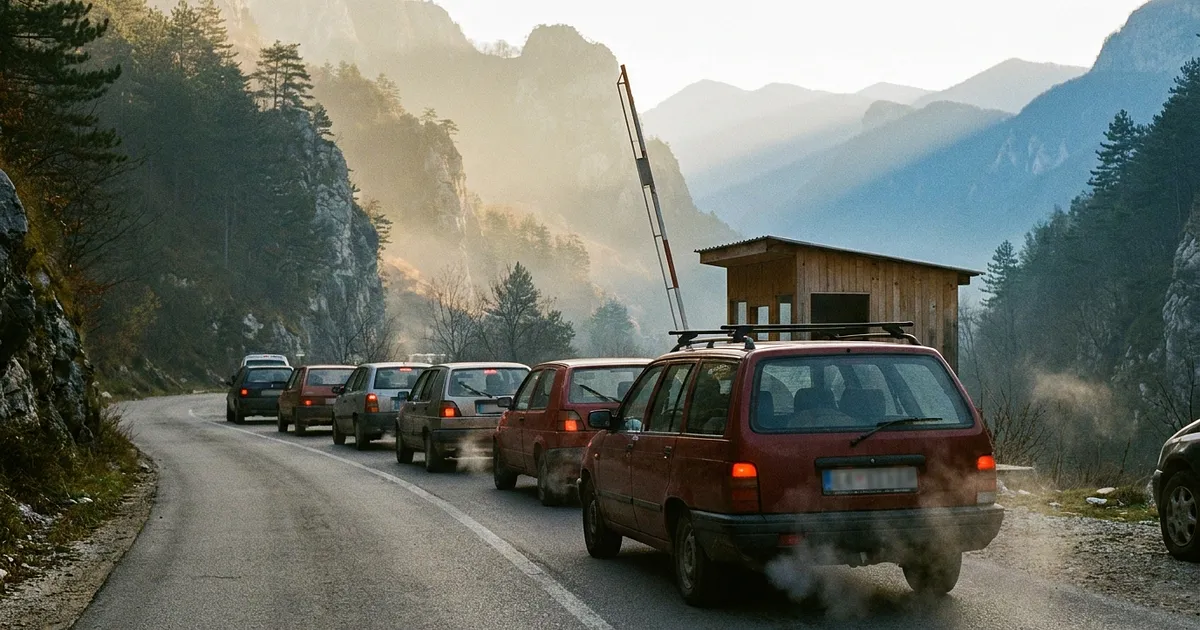
Just after seven in the morning, the queue at the border hut hasn't moved in twenty minutes, and there's nothing to do but look at your screen. A Balkan road trip is, to a surprising degree, made of waiting. Waiting for the stamp. For the Green Card insurance paper. For the camper van ahead of you whose driver is still sorting through a stack of documents. There used to be one more thing at exactly this spot: the kiosk behind the barrier, the question about a local SIM, the fiddling with a pin and a tiny plastic tray. That part is gone.
On a Balkan road trip through Croatia, you won't notice a thing
While the route stays inside Croatia, your phone is a non-issue. "Roam like at home" applies across the EU until at least 2032. Your data allowance keeps running exactly as it does at home. No surcharge, no setting to change, nothing to touch.
Which is precisely why so many people underestimate that first non-EU border. Croatia already feels like the Balkans when you're driving it, all switchbacks and ridgelines and coffee in small cups. Your contract disagrees.
Past the first non-EU border: what a Balkan road trip really costs your plan
Bosnia and Herzegovina, Montenegro, Albania, North Macedonia, Serbia, on a Balkan road trip you'll likely drive through most of them. None of them is an EU member, and most European home plans stop being generous the moment you're inside one. Either data roaming isn't included at all, or it's billed by the gigabyte. For EU travellers, rates of up to 14 euros per gigabyte currently apply, as of 2026. What your own operator charges is in your own price list, not in this article. The order of magnitude holds anyway: double-digit sums for the amount of data a single day of navigating burns through.
Will that change? Probably. Just not this summer. On 4 June 2026 the Council of the EU authorised negotiations on extending EU roaming to the six Western Balkans partners. Negotiations. Not entry into force.
The Balkan agreement doesn't cover your number
Here's the odd part. The Western Balkan countries have had their own roaming agreement since 2021. Someone living in Sarajevo browses in Podgorica at home rates. Your German or British number gets nothing out of it. You drive between two roaming-free zones and belong to neither.
That's the gap a regional profile on a travel eSIM fills: loaded digitally before you leave. After that, no kiosk, no passport on a shop counter, no registration form in a language you can't read. How to run that profile alongside your home SIM so people can still reach you on your old number is a separate topic, and the Abroadmode guides walk through it properly.
The border stands still. The network doesn't.
The rest of the border is as tedious as it ever was, by the way. Between Montenegro and Croatia, driving reports mention waits of up to five hours, which is why seasoned drivers suggest the detour through Bosnia instead. Five hours, for a single stamp in a passport.
Then there's the paperwork that is still, stubbornly, made of paper. Licence, vehicle registration, a rental agreement that permits cross-border travel, a Green Card for the non-EU legs. None of it has a digital shortcut.
On a Balkan road trip, the one thing that sorts itself out as you roll across the line is the phone in your pocket. It finds a new network, registers, done. The friction at the border stayed. The friction in the phone left.
Up in the mountains, no eSIM saves you
So your Balkan road trip doesn't sound too smooth: signal gets weaker on mountain passes and in remote valleys, in northern Albania, in Montenegro's interior, on the back roads towards Kosovo. That has nothing to do with the eSIM. A dead zone is a dead zone, and a plastic card bought in the valley shop wouldn't have changed it either.
Download the offline map for the Balkan road trip before you set off and the problem mostly disappears. Skip it and you learn the lesson once, then never again.
What actually changes about planning
The interesting thing is what's missing from the travel write-ups. The big Balkan road trip itineraries explain border formalities, rental car documents and ferry timetables down to the last detail. Almost none of them spends a sentence on the phone. Probably just because it works, and nobody writes about the things that work.
On a Balkan road trip, something shifts anyway. A route that used to be planned around where you could buy a SIM now organises itself around driving times, border opening hours and where there's a free bed tonight. You book the guesthouse in Theth while the tank fills up in Shkodër. You check the queue at a crossing before you join it. It isn't a huge thing, but it's the difference between a trip decided in advance and one decided on the road.
Which regional plan actually covers your route, and what it costs, changes almost monthly. The current eSIM comparisons by destination live on Abroadmode, each with the date it was checked, so you aren't budgeting with prices from two years ago.
And the kiosk behind the barrier, six borders and a good two or three weeks into the route? It sells coffee now. Honestly the better deal on any Balkan road trip.
Frequently Asked Questions
Do I need a separate SIM card for every country on a Balkan road trip?
No. A regional plan on a travel eSIM usually covers several Balkan countries in one profile, mixing EU members like Croatia with non-EU countries like Bosnia, Montenegro or Albania. At each border the phone registers on the next network by itself. The thing worth checking before departure is whether your chosen plan really lists every country on your route.
Does my home mobile plan work in Bosnia, Montenegro or Albania?
Technically almost always, financially usually badly, which is exactly why an eSIM abroad pays off on a route like this. These countries are not EU members, so EU roaming rules don't apply. Depending on your plan, data roaming is either excluded entirely or billed per gigabyte, in the region of 14 euros per gigabyte for EU travellers as of 2026. Your own exact rate is in your operator's price list.
Does EU roaming already cover the Western Balkans?
Not yet. On 4 June 2026 the Council of the EU authorised negotiations with the six Western Balkans partners so they can later join the roam-like-at-home zone. Agreeing, signing and bringing such a deal into force country by country takes time. For a trip this season, plan as though the rule doesn't exist.
Does the Balkan countries' own roaming agreement help me?
Not at all. The agreement has run since 2021 and lets residents of the six Western Balkans territories call and browse at home rates across those territories. A SIM issued in an EU country isn't covered. As a visiting traveller you move between two roaming-free zones without belonging to either one.
Will an eSIM give me signal everywhere?
No, and that's not down to the eSIM for the Balkans you're using. On high passes, in narrow valleys and across thinly populated mountain regions the network is weak or absent, whether the profile was loaded digitally or slotted in as a card. Downloading offline maps beforehand and having a rough sense of the day's route solves it in practice.
Sources
- until at least 2032 engadget.com
- rates of up to 14 euros per gigabyte currently apply fuel-prices.eu
- authorised negotiations consilium.europa.eu
- have had their own roaming agreement since 2021 en.wikipedia.org
- driving reports mention waits of up to five hours undiscoveredbalkans.com
- signal gets weaker on mountain passes and in remote valleys bnadventure.com
- Balkan road trip itineraries earthtrekkers.com