Best Action Camera for Travel 2026: GoPro vs DJI vs Insta360
 12 min read
Three cameras, three price tags between 299 and 520 euros, and not one of them is a bad buy. That is the real headache when you pick the best action camera for travel in 2026. The question stopped being "which one is good" a while ago. Now it is "which trade-off fits my trip." Cold on the mountain, size in your carry-on, 360° freedom for spontaneous moments, low light in the old town after dark. You are packing right now, and you want an answer, not a spec-sheet war. That is what you get here, from a traveller's point of view.
The 2026 comparison at a glance
Before the detail, here are the four travel flagships side by side. Every figure comes from the manufacturers' own spec pages, prices are Amazon.de figures as of 10 Aug 2026, and they can change any time.
| Model | Video | Stabilisation | Waterproof (no housing) | Battery | Weight | Price (as of 10 Aug 2026) |
|---|---|---|---|---|---|---|
| GoPro HERO13 Black | 5,3K60 / 4K120 | HyperSmooth 6.0 | 10 m | 1900mAh, over 1.5 h at 5,3K30 | 154 g | 344,90 € |
| DJI Osmo Action 5 Pro | 4K120 | RockSteady 3.0 | 20 m | 1950mAh, up to 240 min | 146 g | 299,00 € |
| Insta360 X4 | 8K30 (360°) | FlowState + 360° Horizon Lock | 10 m | 2290mAh, up to 135 min at 5,7K30 | 203 g | 520,00 € |
| Insta360 Ace Pro 2 | 8K30 / 4K60 | FlowState | 12 m | 1800mAh, approx. 180 min | 177 g | 379,00 € |
One point about resolution that most roundups skip: the X4's 8K30 is 360° footage, meaning the full sphere, from which you later crop a flat frame. The usable flat-video resolution after that is a fair bit lower. So don't line up 8K30 (360°) and 5,3K60 as if they were directly comparable numbers. That's not Insta360 bashing, just physics.
GoPro HERO13 Black: the safe pick for accessory fans
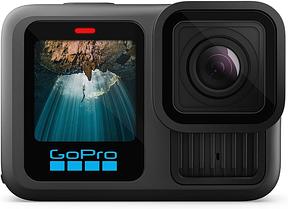
GoPro is still the benchmark everyone else measures against, and there's a solid reason for it. According to GoPro, the HERO13 Black shoots 5,3K60 with HyperSmooth 6.0, is waterproof to 10 metres and weighs 154 grams including the battery. On paper, 5,3K30 clips run "over 1.5 hours" at a stretch, 1080p30 "more than 2.5 hours."
The real travel advantage is none of that. It's the accessories. Mounts, cases, HB-series lens mods: you can find them worldwide, secondhand, rented, in an electronics shop at your destination. Lose a mount on the road and you'll get a replacement. No other brand has that reach.
Who is it not the first choice for? Winter travellers. Its sensor, at 1/1,9", is the smallest here, and GoPro doesn't publish a cold-weather runtime figure the way DJI does. Film at night or at dusk and you'll see it in the noise.
Affiliate link. Buying through it earns us a commission; the price stays the same for you.
DJI Osmo Action 5 Pro: light, cold-proof, cheap
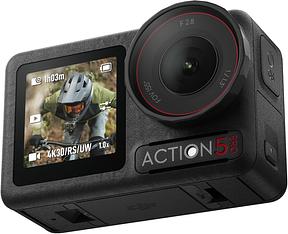
This is my pick for most people. Not because DJI is the loudest brand, but because the numbers just line up for travel. According to DJI's official specifications, the Osmo Action 5 Pro is rated for temperatures from -20°C to 45°C and weighs only 146 grams. DJI separately claims up to 240 minutes of runtime, and even advertises around 3.6 hours of recording at -20°C.
One honest caveat: those cold figures are DJI's own claims, not an independent lab test. I haven't tested three cameras side by side in freezing conditions, and I didn't find a clean three-way cold comparison in the research either. As a rough rule of physics, a battery good for two hours at room temperature can drop to well under an hour near freezing. So DJI's cold rating is a genuine argument for skiing or high-altitude hiking, but don't bank blindly on the exact number of hours.
The larger sensor (1/1,3") also helps in low light. And on price, at 299 € it is the cheapest of the top tier. No surprise it scored 89 out of 100 with the Adventure Combo in the Testsieger.de comparison of chip.de's tests, just ahead of the GoPro HERO13 Black (87 points). DJI beating GoPro in a German test surprises a lot of people. Me too, honestly.
Affiliate link. Buying through it earns us a commission; the price stays the same for you.
Insta360 X4: 360° for anyone who doesn't want to aim in the moment
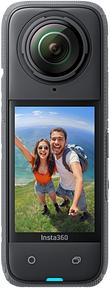
The X4 plays a different game. Instead of pointing in one direction, it records everything, the whole sphere, and you decide at your laptop where the "camera" looks. For spontaneous travel moments that's worth a lot: you never have to point in exactly the right direction at exactly the right split second. The Insta360 X4 records 360° video in up to 8K30 and is waterproof to 10 metres out of the box.
The price for that is real. At 520 € (as of 10 Aug 2026) it's the most expensive here, at 203 grams it's also the heaviest, and battery life at 8K sits at only around 75 minutes. The reframing eats time in editing, too. If you just want quick, good clips from the beach and don't like editing, this is the wrong camera. If you capture road trips, group moments and "what exactly happened there" scenes, you'll love it.
Affiliate link. Buying through it earns us a commission; the price stays the same for you.
Insta360 Ace Pro 2: the night specialist
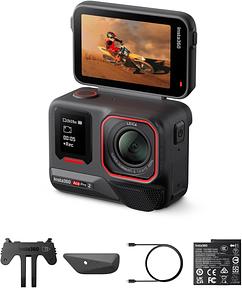
If your trip happens in the evening, night markets, bars, half-lit alleys in the old town, this becomes the most interesting camera here. The Insta360 Ace Pro 2 uses a 1/1,3-inch sensor co-engineered with Leica and is waterproof to 12 metres. Add 8K30, 4K60 with Active HDR, and a flip screen for filming yourself.
It's not a 360° camera like the X4, but a classic front-facing cam, just with the best low-light reputation in the field and strong stills quality thanks to the Leica lens. In chip.de's scoring it finished behind the others with 81 out of 100, which tells you something: in bright, standard situations it barely gets to show its strength. Buy it for the night advantage, not as an all-rounder.
Affiliate link. Buying through it earns us a commission; the price stays the same for you.
GoPro vs DJI vs Insta360: which one fits how you travel?
Forget the brands for a second. Ask first how you travel. After that, the choice almost makes itself.
Beach, snorkelling, watersports: all four are waterproof without a housing, but the DJI goes deepest at 20 m. For actual diving you'll need an extra dive case on any of them.
Skiing, mountains, winter cities: the DJI Osmo Action 5 Pro wins here through its cold rating and long runtime away from a socket.
City break after dark: the Ace Pro 2 with the Leica sensor pulls ahead.
Road trip, festival, group moments: the X4's 360° freedom captures what a fixed lens misses.
First action cam, need accessories on location: GoPro HERO13, because of the ecosystem.
Review teams like TechRadar sum it up much the same way: GoPro scores on stabilisation and accessories, DJI on battery life and low light, Insta360 on 360° flexibility. There is no overall winner. There's just your winner.
Budget alternative: the compact action cam under 100 euros
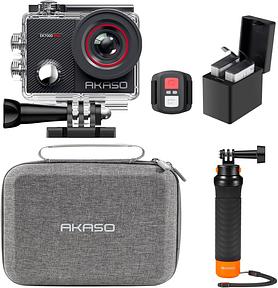
Not every trip needs a 300-euro device. If the camera only joins your carry-on every few months, or you can't keep an eye on it at the beach, a mini action camera does the job without the loss hurting. The AKASO EK7000 Pro shoots 4K30, is waterproof to 40 metres with a case, and costs 93,48 € (as of 10 Aug 2026). Its 20,000-plus Amazon reviews at 4.3 stars tell you it delivers for the money.
You still have to stay honest, though. The stabilisation doesn't reach HyperSmooth or RockSteady, it noises up earlier in low light, and the app is fiddlier. As a second camera for the water, or a starter for a kid on the road, it's great. As the only camera for the photo trip of your life, I wouldn't take it.
Affiliate link. Buying through it earns us a commission; the price stays the same for you.
The right microSD card: the underrated failure point
This is the part almost every "best action camera" comparison skips, and the one that can wreck your trip. The best camera is useless with the wrong card. According to Insta360's official hardware specification, you need at least a V30 (UHS-I) speed-class microSD card, and that applies across all three ecosystems at high bitrates.
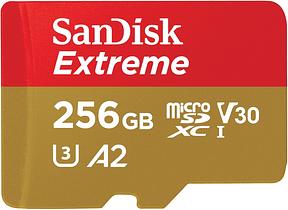
Here's the catch: plenty of cheap cards advertise "4K-ready" but carry only Class 10 or U3, not the explicit V30 badge. Put one of those in the camera and you risk the worst case on a trip: dropped frames or corrupted clips from a moment you can't reshoot. So check for the explicit V30 (or higher) badge, and pack one card more than you think you need. For multi-day trips with no laptop to offload to, I'd go 256 GB, so you never have to delete anything on the road. A proven choice is the SanDisk Extreme at 256 GB, V30-certified, with 190 MB/s transfer, for 56,99 € (as of 10 Aug 2026).
Affiliate link. Buying through it earns us a commission; the price stays the same for you.
Lithium batteries in your carry-on: the flight rules nobody explains
Now the topic where generic camera guides go completely silent, because they're written for buyers, not for flyers. Your spare batteries go in your carry-on. Always. According to IATA, lithium-ion batteries up to 100 Wh may be carried in hand luggage without approval, and spare batteries belong in hand luggage only, never in checked baggage.
The good news: no battery in this comparison comes anywhere near the limit. Do the math yourself, the formula is mAh times volts divided by 1000. The GoPro at 1900mAh lands at roughly 7.3 Wh, the DJI at 1950mAh around 7.5 Wh, the X4 at 2290mAh just under 8.8 Wh. All miles below the 100 Wh at which an airline would need to sign off. So you can carry several spares without a problem.
The one mistake that stops you at security, or breaks the rules: spare batteries in checked luggage. Tape over the terminals or put each battery in its own small pouch, and you're on the safe side. Two or three spares easily cover a long shooting day away from a socket.
Backing up footage on the road without blowing your data plan
A 4K or 8K file is big. Really big. Push every clip straight to the cloud on holiday and you'll burn through your data faster than you'd think, especially on a local eSIM or expensive roaming. So back up offline first. The 256 GB V30 card is your first backup, a small USB stick or SSD for the hotel room your second.
Cloud upload then, but on purpose, not automatically. Upload the important clips over hotel Wi-Fi, not over mobile data. And if you want reliable connectivity abroad without the roaming trap, it's worth reading our eSIM provider comparison for travellers first. A 5 GB plan is there for maps and messengers, not for 30 GB of raw footage.
Conclusion
The best action camera for travel in 2026 isn't a single camera, it's the one whose trade-off fits your trip. The DJI Osmo Action 5 Pro is the smartest buy for most: light, cold-proof, cheap. The GoPro HERO13 Black wins on accessories, the Insta360 X4 on freedom, the Ace Pro 2 in the dark.
And before you're standing at the airport: spares in the carry-on, a V30 card with enough room in the camera, and a suitable eSIM on your phone so you can upload your clips from the hotel without blowing your data plan. Then the camera can do what you bought it for: capture the trip, not cause trouble.
All products from this post
The ones we named above are marked; the rest are alternatives in the same category.
Affiliate notice: As an Amazon Associate, we earn from qualifying purchases. Product prices and availability are subject to change.
Frequently Asked Questions
Which action camera is best for travel in 2026?
For most travellers, the DJI Osmo Action 5 Pro: lightest in the field (146 g), strong battery life, rated by DJI down to -20°C, and at 299 € the cheapest of the flagships. Want maximum accessories? Take the GoPro HERO13 Black. Need 360° freedom? The Insta360 X4. Film a lot at night? The Ace Pro 2. There is no single winner for everyone.
Can I bring spare action-camera batteries in my carry-on?
Yes, and you have to. Under IATA rules, spare lithium batteries belong in hand luggage only, never in checked baggage. Every battery in this comparison sits at roughly 7 to 9 Wh, well below the 100 Wh threshold where an airline would need to approve them. Several spares are no problem. Tape over the terminals to be safe.
Which microSD card do I need for 4K and 5,3K video?
At least a V30 (UHS-I) speed-class card, which is the official floor for all three brands at high bitrates. Look for the explicit V30 badge, not just a "4K-ready" label. For multi-day trips with no laptop to offload to, 256 GB is handy, so you never have to delete anything on the road.
Is an action camera waterproof enough to snorkel without a housing?
For surface snorkelling, yes: GoPro and the Insta360 X4 are sealed to 10 m, the DJI Osmo Action 5 Pro to 20 m, the Ace Pro 2 to 12 m. For real diving at depth you'll need an extra dive case on any of them. Always rinse the camera with fresh water after salt water, or the seal suffers.
Is a cheap action camera under 100 euros worth it for travel?
As a second or entry-level camera, yes. The AKASO EK7000 Pro shoots 4K30 and costs under 100 €, great for the water or for a kid on the road, where a loss shouldn't hurt. But on stabilisation and low light it sits clearly behind GoPro and DJI. As the only camera for an important photo trip, I wouldn't take it.