Best GaN Travel Charger 2026: USB-C Multiport Compared
 12 min read
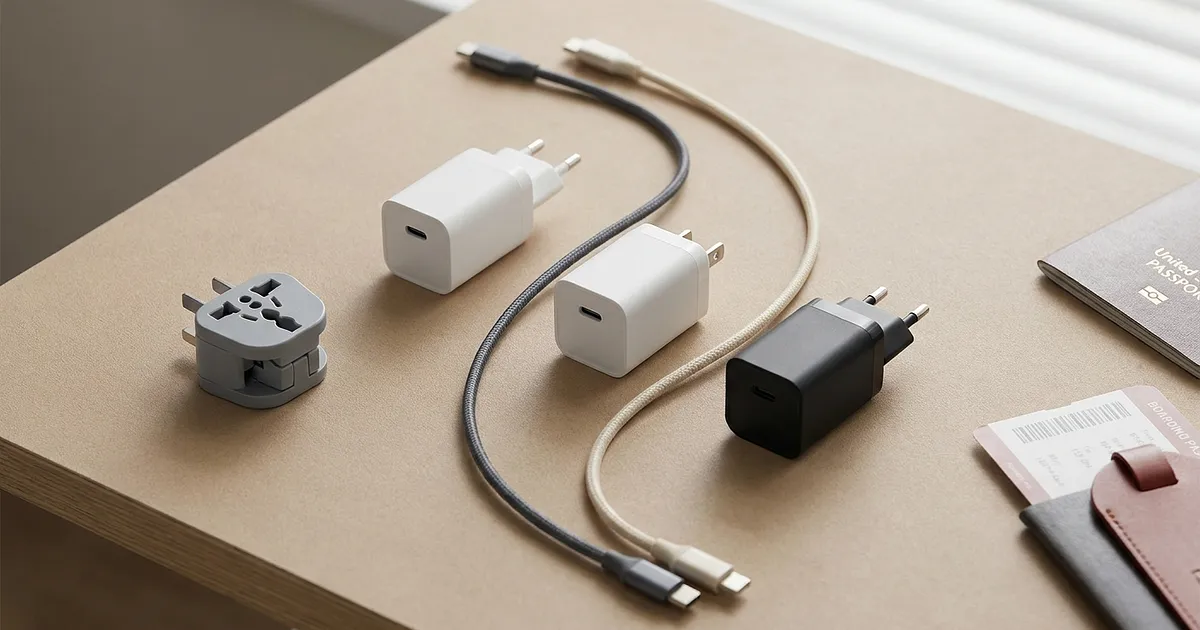
You're standing in an airport in Tokyo, you pull your charger out of your backpack, and you wonder: will my normal plug work, or is the Japanese outlet about to fry my adapter? I hear this from travelers all the time. And the answer is far more reassuring than most people expect. A modern GaN travel charger handles almost everything on its own, and the thing you actually need to pack is rarely the thing travel forums push first.
Sounds almost too simple. It isn't. The catch sits in the wattage and the port count, and that's exactly where a lot of people buy the wrong thing. Too little power, and your laptop crawls. Too much, and you're hauling extra weight and money for ports you'll never touch. This comparison shows you which setup fits which trip.
GaN travel chargers for 2026 at a glance
Six picks, from the pocket-sized minimalist option to the premium model with a display. All prices and ratings are retailer data from amazon.de, as of August 2026, and they shift over time.
| Model | Power | Ports | Price (Aug 2026) | Rating | Best for |
|---|---|---|---|---|---|
| Anker 511 (Nano 3) | 30W | 1x USB-C | 12,99 € | 4,7★ (11.976) | phone only, minimalists |
| UGREEN Nexode 65W | 65W | 3-Port | 19,99 € | 4,6★ (9.202) | most travelers |
| UGREEN Nexode 100W | 100W | 4-Port | 31,97 € | 4,6★ (7.655) | laptop plus family |
| Baseus Enerfill 100W | 100W | 3-Port | 31,99 € | 4,5★ (758) | compact 100W option |
| Anker Prime 140W | 140W | 4-Port | 75,80 € | 4,7★ (3.220) | power users, workstations |
| Anker USB-C cable | 100W PD | 1,8m | 6,97 € | 4,7★ (43.983) | the part people forget |
My honest take up front: for a good two thirds of travelers, the 65W class is the sweet spot. Everyone else should keep reading, because there are exceptions.
What GaN actually means, and why it's smaller
GaN stands for gallium nitride, the semiconductor that has replaced older silicon inside modern chargers. According to Anker, gallium nitride conducts electricity more efficiently than silicon and wastes less energy as heat. Less heat loss means, in practice, a smaller shell, less weight, and cooler running.
How much smaller? A 100W GaN charger is roughly 60% smaller than a comparable silicon charger, according to Navitas and SHARGE. And that was already true back in 2021, so the tech has only improved since. In your carry-on, that's the difference between a chunky brick and something that slips into a trouser pocket.
That's the real reason to switch. Not charging speed, which is nearly identical at the same wattage. It's space and weight. Anyone who has ever wrestled three separate power bricks through security, one each for laptop, phone and watch, knows the feeling.
USB-C Power Delivery: how many watts does each device need?
This part gets briefly technical, but it pays off, because after this you won't buy the wrong thing.
The charging standard is called USB-C Power Delivery, or PD. It negotiates automatically between the charger and the device, deciding how much voltage and current flow. Under USB PD 3.1, a single USB-C cable can carry up to 240W, where the old ceiling was 100W. Phones get an extra layer called PPS. Renesas explains that PPS adjusts voltage in 20mV steps to charge phones faster and cooler.
Now the part that matters, the demand per device:
A smartwatch never pulls more than about 12W, according to Apple, even on a 96W brick. Usually 5W is plenty.
A smartphone sits somewhere between 20W and 30W depending on the model.
A laptop splits into three classes, per HP: 45W covers Chromebooks and thin ultrabooks, 65W handles most 13-14 inch laptops, and 100W and up gets you into gaming and workstation territory.
Add that up. A 45W laptop plus a 20W phone plus a 5W watch is 70W. A 100W charger runs all three at once without breaking a sweat. Even a 65W unit manages it, as long as the laptop isn't rendering at full tilt. Remember one thing: the device decides how much it draws, not the charger. A 100W brick won't overrun your phone. It delivers exactly what the phone asks for.
The best GaN travel chargers of 2026 in detail
Anker 511 (Nano 3), 30W: the single-port featherweight for phones
If all you want is to charge a phone and nothing else, you don't need a multiport slab. The Anker 511 is barely bigger than the original Apple cube, yet it puts out 30W over one USB-C port with PPS. That's full charging speed for any current phone, plus a smartwatch on the side if you swap them out.
Who it's not for: anyone traveling with a laptop too. 30W will trickle-charge a MacBook, but under load the battery still drains. As a second charger for the hotel nightstand, though, it's ideal. At around 13 euros, tucking a spare into your toiletry bag doesn't hurt either.
Anker 30W USB C Ladegerät, GaN 511 Nano 3, PIQ 3.0 PPS Schnellladegerät
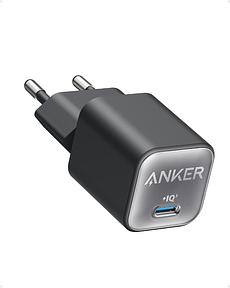
Anker 30W USB C Ladegerät, GaN 511 Nano 3, PIQ 3.0 PPS Schnellladegerät
View at AmazonAffiliate link. Buying through it earns us a commission; the price stays the same for you.
UGREEN Nexode 65W: the do-everything pick for most people
This is my default recommendation, and here's why. 65W across three ports hits the exact point where a charger runs laptop, phone and watch at once without making you pay for power you'll never call on. The price of just under 20 euros makes the choice even easier.
A 13 inch laptop charges to full on it, a phone charges fast, the watch barely notices. Plug all three in at once and the charger splits the power. The laptop might get 45W instead of 65W, which is plenty for normal work.
Who it's not for: owners of big 16 inch workstations or gaming laptops that pull more than 65W under load. Those folks should look further down. For everyone else, 4,6 stars from over 9.000 ratings makes this a safe bet.
UGREEN Nexode 65W USB C Ladegerät, 3-Port, GaN Netzteil, PPS Charger
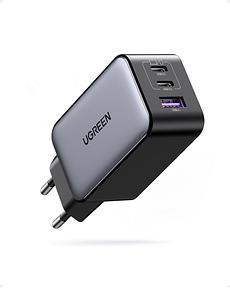
UGREEN Nexode 65W USB C Ladegerät, 3-Port, GaN Netzteil, PPS Charger
View at AmazonAffiliate link. Buying through it earns us a commission; the price stays the same for you.
UGREEN Nexode 100W: laptop power with four ports
Once two laptops or a whole travel party share one brick, 100W over four ports gets interesting. The UGREEN Nexode 100W charges a large laptop to full and still has ports free for a phone, tablet and watch. For families or couples who want to top everything up at once in the evening, this is the most relaxed solution.
Around 32 euros is fair for the power on offer. The only downside versus the 65W class is the slightly bigger body. Still tiny next to four separate power bricks, just no longer pocket-small.
UGREEN Nexode 100W USB C Ladegerät, 4 Ports, GaN Netzteil, Laptop Charger
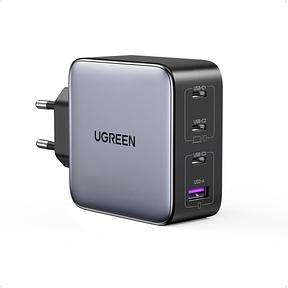
UGREEN Nexode 100W USB C Ladegerät, 4 Ports, GaN Netzteil, Laptop Charger
View at AmazonAffiliate link. Buying through it earns us a commission; the price stays the same for you.
Baseus Enerfill 100W: the compact 100W alternative
If you want 100W but would rather have three ports than four and a slightly more compact body, the Baseus Enerfill is a solid alternative to the UGREEN. On price the two sit almost level at roughly 32 euros. The difference is in the detail: three ports instead of four, but often the slimmer shape.
Honestly, there's little between these two 100W units. At 4,5 stars from just 758 ratings, the Baseus has simply gathered less long-term feedback than the established UGREEN. If you're wary of the risk, go with the more proven model. If you like the more compact form, this one's right for you.
Baseus Enerfill USB C Charger 100W, 3-Port USB C Power Supply, GaN Fast Charger
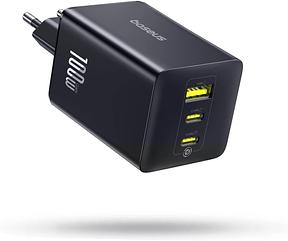
Baseus Enerfill USB C Charger 100W, 3-Port USB C Power Supply, GaN Fast Charger
View at AmazonAffiliate link. Buying through it earns us a commission; the price stays the same for you.
Anker Prime 140W: premium tier with a display
Now the exception for power users. The Anker Prime delivers 140W across four ports and shows on a small display, in real time, what's flowing to which port. Sounds like a gimmick, but it's surprisingly useful when you want to know whether your laptop is really pulling full power.
140W is enough for the thickest 16 inch workstations and gaming laptops, even two of them at once at reduced speed. At around 76 euros this is no impulse buy, and for most travelers it's simply overkill. But if your laptop is hungry under load and you want to carry only one brick, this is the no-compromise choice. The 4,7 stars from over 3.000 ratings back it up.
Anker 140W USB C Ladegerät, Laptop Ladegerät, 4-Port Multi-Geräte Netzteil (Prime)
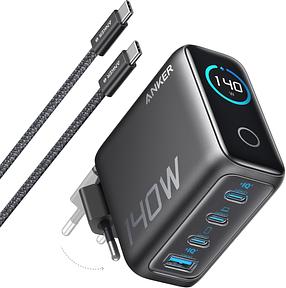
Anker 140W USB C Ladegerät, Laptop Ladegerät, 4-Port Multi-Geräte Netzteil (Prime)
View at AmazonAffiliate link. Buying through it earns us a commission; the price stays the same for you.
Don't forget the cable
One detail surprisingly many people trip over: the best 100W charger is useless if your cable only passes 60W. Plenty of older USB-C cables are rated for low power and quietly throttle. The Anker USB-C cable carries the full 100W PD 3.0 over a 1,8m length, and that length is worth its weight in gold on the road, when the outlet is hiding behind the bed again.
At under 7 euros and with nearly 44.000 ratings at 4,7 stars, this is one of the easiest calls in the whole comparison. Pack two.
![Anker 100W USB C auf USB C Kabel PD 3.0 Schnellladen [1,8m]](https://abroadmode.com/rails/active_storage/representations/proxy/eyJfcmFpbHMiOnsiZGF0YSI6MTQ0MTEsInB1ciI6ImJsb2JfaWQifX0=--cd7eb6332e44c89c324d3f6d6284786082e0b755/eyJfcmFpbHMiOnsiZGF0YSI6eyJmb3JtYXQiOiJqcGciLCJyZXNpemVfdG9fbGltaXQiOlsyODgsMjg4XX0sInB1ciI6InZhcmlhdGlvbiJ9fQ==--b7a7af1d9490199d0a8048d8ed5b80d3fb201a3c/products-B09LPXJ3RX.jpg)
Anker 100W USB C auf USB C Kabel PD 3.0 Schnellladen [1,8m]
View at AmazonAffiliate link. Buying through it earns us a commission; the price stays the same for you.
Plug adapter or voltage converter? The expensive travel myth
Here's the part that might save you money and luggage weight. The most common mistake travelers make is assuming they need a heavy voltage converter for the US or Japan so the charger doesn't burn out.
Wrong, in almost every case. Dell puts it plainly: "A travel adapter only changes the physical shape of your plug to fit power outlets; it doesn't change the voltage." And that's all you need, because nearly every modern USB-C charger reads "Input: 100-240V" on the label. That brick converts the mains voltage, whether it's 110V in the US or 100V in Japan, all by itself. Just check the fine print on your charger. If it says 100-240V, you only need the plug adapter.
So when do you actually need a voltage converter? Only for old single-voltage devices hardwired for 230V. A cheap travel hairdryer, say. For your charger, your laptop brick and your phone, never. One travel blogger took a single plug adapter across three countries in Asia for a GaN multiport charger, with no voltage converter at all, through three different outlet types.
And the second myth, right on its heels: more watts does not automatically mean faster. A 100W charger won't charge your 27W phone a single second faster than a matching 30W unit. The higher wattage only helps when a device can actually draw it, meaning your laptop. For a phone alone, a 140W monster is wasted money.
The bottom line
If you remember one number, make it 65W. For the vast majority of travelers the UGREEN Nexode 65W is the right call, because it charges phone, laptop and watch at once, weighs almost nothing, and costs under 20 euros. Got a hungry 16 inch laptop? Step up a class to 100W, or go straight for the 140W premium tier. Only charging a phone? The 30W featherweight does the job.
But the most important thing isn't in the wattage. It's on your charger's label. If it reads 100-240V, you can travel the whole world with it. One light plug adapter in your bag, and the heavy voltage converter stays home, where it belongs.
All products from this post
The ones we named above are marked; the rest are alternatives in the same category.
Affiliate notice: As an Amazon Associate, we earn from qualifying purchases. Product prices and availability are subject to change.
Frequently Asked Questions
Do I need a voltage converter for my GaN travel charger in the US or Japan?
No. Almost every modern USB-C charger is labeled "Input: 100-240V" and converts the mains voltage automatically anywhere in the world. All you need is a plug adapter that matches the outlet shape. A voltage converter is only needed for old single-voltage devices like some travel hairdryers, never for your charger or laptop brick.
How many watts does a GaN travel charger need for a laptop, phone and watch together?
For most setups, 65W to 100W is plenty. A typical 13 inch laptop pulls 45W to 65W, a phone 20W to 30W, and a smartwatch at most around 12W. Together that often lands at 70W to 90W. A 100W multiport unit runs all three at once with ease, and a 65W unit copes in daily use nearly every time.
Is a GaN charger really smaller than my old brick?
Yes, noticeably. A 100W GaN charger is roughly 60% smaller than a comparable silicon charger, according to Navitas and SHARGE. Gallium nitride switches more efficiently and wastes less energy as heat, so the housing can shrink. For you that means less weight and space in your carry-on, at the same or better charging output.
Can a 100W charger damage my phone?
No. Through the USB-C Power Delivery standard, the device decides how much power it draws, not the charger. A 100W brick gives your phone only the 27W or 30W it requests. The surplus power just goes unused. A stronger charger is always safe, it simply won't charge small devices any faster.
What's the difference between PD and PPS?
PD stands for Power Delivery, the USB-C charging standard that negotiates voltage and current per device, up to 240W on PD 3.1. PPS is an extension of it that fine-tunes voltage in small 20mV steps, mainly so smartphones charge faster and cooler. For laptops and watches PPS barely matters, but for a phone it does.