Dashcam for Road Trips and Rental Cars Abroad: Test and Buying Guide 2026
 15 min read
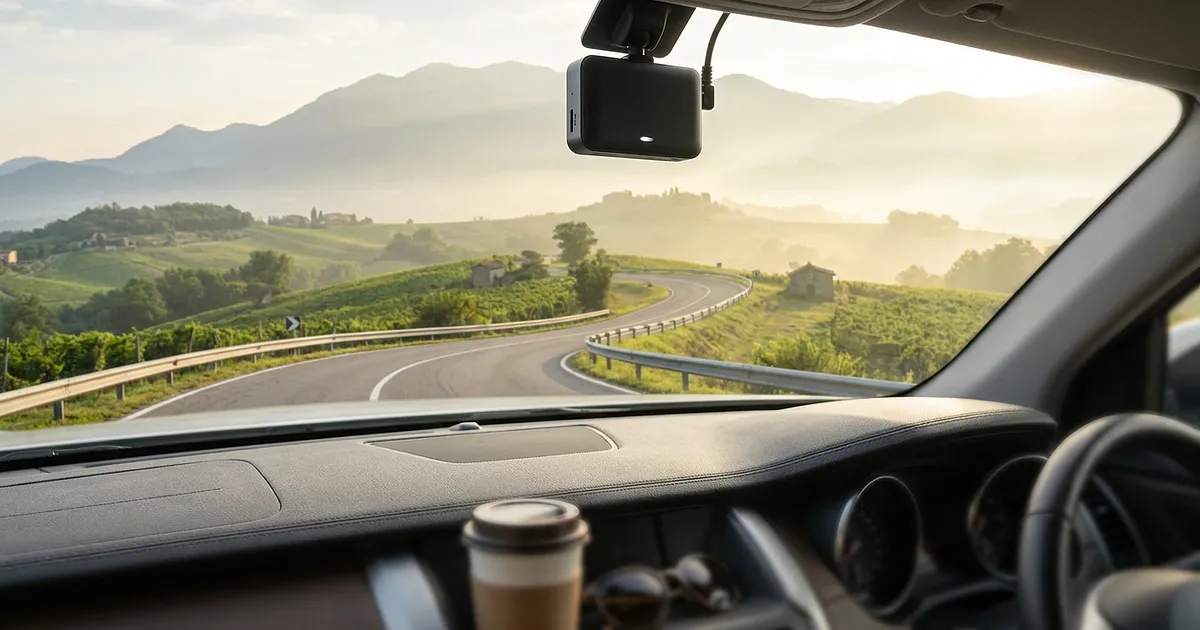
Your rental car is waiting at Faro airport, the coast road is calling, and somewhere between your passport and your charging cable sits the question almost nobody asks before setting off: is the dashcam even allowed across the border? In Germany the camera is broadly tolerated. At the Swiss border it suddenly becomes a matter of dispute. And in Austria, a missing warning sticker can get expensive fast.
That's the blind spot in most buying guides. They show you the sharpest 4K resolution and the best parking mode, but nobody explains how to run the thing in a car that isn't yours, while you drive through three countries with three different legal regimes in a single week.
Why a dashcam earns its place on a road trip
Honestly, on most holiday drives nothing ever happens. But when it does, it often comes down to one person's word against another's. A rear-end shunt in a Naples roundabout, a lane-change argument on the motorway, a parking scrape in the hotel lot. Without witnesses and without footage, that gets slow abroad, especially when the language barrier is real and the rental company quietly bills your excess.
The market has matured around exactly this. According to market estimates, Germany is Europe's single largest dashcam market, with something like a quarter to nearly a third of all passenger cars already carrying one. One UK insurer reported that dashcam footage proved a driver's innocence in close to 40 percent of the disputed claims it looked at. That figure comes from the UK and doesn't transfer to the German-speaking market, but it does explain why people buy the thing at all.
For you as a renter, one thing matters most: proof if there's a crash. Everything else, overnight parking mode, 24/7 surveillance, is more ballast than benefit in a borrowed car. More on that below.
Legal status in Germany: allowed, with an asterisk
Let's start at home, because the biggest myth lives here. As the ADAC explains, dashcams in Germany may only film briefly and for a specific reason. Continuous, unprompted recording breaks data protection law. The trick that keeps the camera usable anyway is called loop recording: the device records in short segments and constantly overwrites itself, and only an impact makes the G-sensor lock a clip for good.
Sounds settled? Not quite. In its 2019 position paper, Germany's Data Protection Conference states that dashcam use is barely permissible from a data-protection standpoint. One state authority in Lower Saxony even floated around 30 seconds as an informal benchmark for maximum retention. There are documented three-digit euro fines in Bavaria and Hesse. So "allowed" isn't the same as "no problem."
What the BGH ruling actually says
The Federal Court of Justice ruled in 2018 (case VI ZR 233/17) that dashcam footage can be used as court evidence despite a data-protection violation. Here's where nearly everyone shortcuts it: the ruling does not make continuous filming legal. It only says a court may admit the footage in a given case if the interest in resolving the dispute outweighs the privacy breach. Two separate questions, constantly lumped into one.
In practice, for a road trip that means: loop mode on, don't dump the clips on social media, done. Anyone who lets the camera run for hours with no trigger and then archives the clips is on thin ice.
Legal status abroad: the country table
Now it gets interesting, because borders that are invisible on a road trip separate completely different legal spaces. Munich to Zurich to Milan, and you've crossed three regimes in one afternoon. The overview below sums up the current picture. Please read it as travel guidance, not legal advice, and check the current situation before you drive, because data-protection interpretation keeps shifting.
| Country | Private use | Continuous filming / publishing | Note (as of 08/2026) |
|---|---|---|---|
| Germany | tolerated | loop/incident only, continuous filming breaches data protection | three-digit fines documented |
| Austria | grey zone | banned, incident-only, warning sticker required | documented case: €300 fine |
| Switzerland | contested | data-protection watchdog against it, motoring club endorses loop use | both positions open, see below |
| Italy | tolerated | don't block your view, overwrite regularly | private use accepted |
| France | tolerated | fine for personal use, inform accident parties | medium source strength |
| Spain | with conditions | operating the device while driving is separately fined | ~€200 for handling it, verify first |
| Netherlands | tolerated | people must not be identifiable in shared footage | GDPR logic, no special rule |
| Belgium | conflicting | partly allowed, sharing only with authorities | sources disagree, act conservatively |
| Luxembourg | banned | not permitted for private vehicles | rare case of clear source agreement |
| Portugal | heavily restricted | the strictest regime in this table | don't rely on footage there |
| Poland | with conditions | easily removable, delete recordings regularly | private use possible |
| Croatia | no specific rule found | unclear, general GDPR rules apply | verify first, thin sourcing |
A few rows deserve a closer look, because they matter most to travellers from the German-speaking region.
Austria: the expensive warning sticker
Austria isn't a ban country, but it's one where checks actually happen. The ÖAMTC puts it plainly: owning a dashcam isn't forbidden, but using it to survey public space is. Only incident-triggered documentation is tolerable, not continuous filming of the road.
How seriously that's meant shows in a concrete case. In one documented case, a driver in Vienna had to pay €300, split into €220 for unlawful operation and €80 because no sticker warned people about the recording, plus costs. Triggered by an ordinary traffic stop. Picture that at a checkpoint in Tyrol, mid-holiday.
Switzerland: the authorities contradict each other
Switzerland is the most honest grey zone on the whole list, and anyone selling you a clean yes or no is oversimplifying. The federal data protection commissioner treats routine dashcam use as unlawful surveillance. Yet at the same time the TCS tests and openly recommends dashcams, as long as you use loop recording and don't publish footage without consent. The TCS is the country's largest motoring club, so its recommendation carries weight. Some lawyers openly disagree with the strict reading, and a revision of the data-protection law is on the table.
Bottom line: plenty of drivers use a dashcam in Switzerland, but there's no clean legal certainty. If you drive there, stick strictly to loop mode, tell your passengers, and publish nothing. And expect the situation to change.
Buying criteria specifically for a rental car
Now the part no standard test covers: what makes a dashcam rental-friendly? A borrowed car has different demands than your own. No drilling, no glue, no wires in the fuse box.
Suction mount, not an adhesive pad. Sticky mounts leave residue, and residue on the windscreen can turn into an argument at drop-off. A suction cup sits in seconds and comes off without a trace.
Power from the 12V socket or cigarette lighter. A hardwire kit taps the car's electrics. You don't want that in someone else's car, and for a few holiday days it isn't worth it anyway. USB cable in, done.
Loop recording and a G-sensor. Both are mandatory, not optional, for the legal reasons above. The G-sensor auto-locks the clip on impact.
Compact and discreet. A small body blocks less of your view, draws less attention at a checkpoint, and slips into the glovebox faster when you park.
Heat resistance. A parked car in southern Europe becomes an oven in summer. Cheap cameras with a lithium battery hate that, which is why many road-trip-friendly models use a more heat-tolerant supercapacitor instead of a battery.
A GPS stamp. Time, date and speed burned into the frame help enormously later when you reconstruct what happened.
Front and rear, if the budget stretches. A two-channel system also films behind you, and rear-end shunts come from exactly there.
What you can safely ignore: the heavily marketed parking mode. It usually needs constant power via a hardwired install and does little in a rental for a few days. For pure driving cover, a simple 12V unit in loop mode is enough.
The right memory card: underrated and decisive
This is where a lot of people save money and regret it later. A normal microSD card isn't built for a dashcam's constant write cycle. Loop recording means non-stop overwriting, around the clock, and an ordinary photo card gives out under that load sooner or later, often exactly when you need the footage.
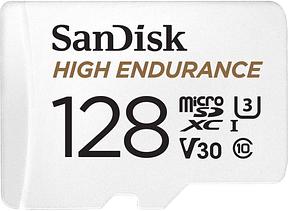
So a high-endurance card built for this write profile belongs in the kit. The SanDisk High Endurance microSDXC Speicherkarte 128 GB + Adapter (Für Dash-Cams und private Überwachungskameras, 100 MB/s Lesen, V30 für Full-HD und 4K-Videos) is one of those, with 128 GB, V30 speed for Full-HD and 4K, and a price of €33.99 (as of 2026-08-10, amazon.de). At over 73,000 reviews and an average of 4.7 stars, it's something like the quiet standard in this category. Buy it alongside the camera, not the €8 card from the spares drawer.
Affiliate link. Buying through it earns us a commission; the price stays the same for you.
2026 model recommendations compared
We haven't personally driven any of these cameras across a thousand kilometres, and claiming otherwise would be dishonest. What follows is a comparison based on manufacturer specs, features and the public ratings on amazon.de (as of 2026-08-10). All prices and stars can move.
Here's the quick overview first, then the per-model detail.
| Model | Resolution | Channels | Rating | Price | Best for |
|---|---|---|---|---|---|
| VIOFO A119 Mini 2 | 2K/1440p | front | 4.6 (835) | €117.59 | value, discreet |
| Garmin Dash Cam Mini 2 | 1080p | front | 4.1 (13) | €114.99 | tiny, thin data |
| 70mai A810S | 4K + 1080p | front + rear | 4.3 (314) | €243.99 | two-channel entry |
| VIOFO A229 Pro 2CH | 4K + 2K | front + rear | 4.5 (494) | €339.95 | premium front+rear |
| Nextbase 622GW | 2160p/4K | front | 3.8 (814) | €264.99 | brand name, mixed |
All figures as of 2026-08-10 (amazon.de).
Value pick: VIOFO A119 Mini 2
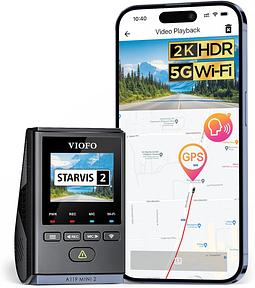
For most road trips, this is the sensible grab. The VIOFO A119 Mini 2 Dashcam Auto, 2K 60fps HDR, 5GHz WLAN, GPS, Parkmodus, Nachtsicht 2.0, Diskretes Design films in 2K/1440p at 60fps, has GPS, 5GHz WiFi for the app, and a deliberately discreet little body that barely shows at the windscreen. At €117.59 it sits in the lower-middle of the range, and its 4.6-star rating across 835 votes is the steadiest in the whole field. Exactly the combination you want in a rental: low-key, solid, no overkill.
Affiliate link. Buying through it earns us a commission; the price stays the same for you.
The ultra-compact option: Garmin Dash Cam Mini 2
If size beats everything for you, the Garmin Dash Cam Mini 2 – ultrakompakte Dashcam mit automatischer Unfallerkennung, 140° Bildwinkel & Kabel für die Konstantstromquelle is barely bigger than a car key. A 140° field of view, automatic incident detection, all but hidden behind the rear-view mirror. We have to stay honest about the reviews though: amazon.de shows only 13 of them at 4.1 stars (as of 2026-08-10). That's a thin data base, and no reliable verdict comes out of it. Garmin has a good reputation as a brand, but we'd file this clearly as the tiny, still-lightly-documented choice, not a top scorer.
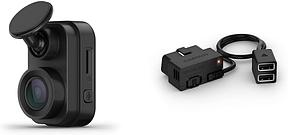
Garmin Dash Cam Mini 2 – ultrakompakte Dashcam mit automatischer Unfallerkennung, 140° Bildwinkel & Kabel für die Konstantstromquelle
Affiliate link. Buying through it earns us a commission; the price stays the same for you.
Two-channel entry: 70mai A810S
The 70mai 4K Dashcam Auto Vorne Hinten A810S, 4K+1080P Dual STARVIS 2 IMX678, HDR, WiFi&App, 24/7 Parküberwachung, 128GB Micro SD-Karte is the cheaper route to front-and-rear cover. 4K up front, 1080p at the back, plus HDR, WiFi, an app, and per the manufacturer a STARVIS 2 sensor for night vision, with a 128 GB card in the box. €243.99 and 4.3 stars from 314 reviews. If you want rear protection without reaching for the premium shelf, this is a fair compromise.
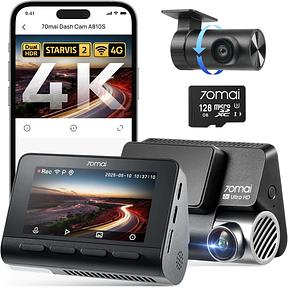
Affiliate link. Buying through it earns us a commission; the price stays the same for you.
Premium front and rear: VIOFO A229 Pro 2CH
If you want the best two-channel image and you're willing to pay for it, you land on the VIOFO A229 Pro 2CH Dashcam, 4K+2K HDR, 5GHz WLAN, GPS, CPL, Nachtsicht 2.0. 4K front, 2K rear, HDR, 5GHz WiFi, GPS and a CPL filter against windscreen glare. At €339.95 it's the priciest model here, but the 4.5 stars from 494 reviews back the ambition. For frequent drivers and long tours it's the luxury choice, for a one-week rental run it's probably more than you need.
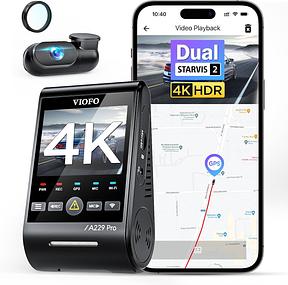
VIOFO A229 Pro 2CH Dashcam, 4K+2K HDR, 5GHz WLAN, GPS, CPL, Nachtsicht 2.0
View at AmazonAffiliate link. Buying through it earns us a commission; the price stays the same for you.
Familiar name, mixed reviews: Nextbase 622GW
Nextbase is one of the most visible dashcam brands in Europe, and the Nextbase 622GW Dashcam Auto Vorne | Parkmodus 24/7 Parküberwachung | 2160p 30fps Dash Cam | 3-Zoll-Bildschirm films in 2160p/4K and brings a 24/7 parking mode. On the rating, though, we have to be straight: 3.8 stars across 814 reviews is the weakest score in this comparison, at a price of €264.99 (as of 2026-08-10, amazon.de). We list it as an established brand option with mixed feedback, not a front-runner. If the brand name and parking mode matter to you, take a look, but read the critical reviews carefully first.
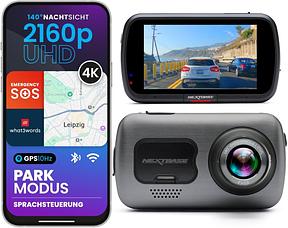
Affiliate link. Buying through it earns us a commission; the price stays the same for you.
Fitting and removing a dashcam in a rental car
Mounting is the easiest exercise in this whole article, if you mind three things. Suction cup behind the rear-view mirror, centred, so the camera doesn't block your view and you keep a clear road. Run the USB cable along the edge of the windscreen to the 12V socket, tucked in loosely, without gluing anything. Check loop mode and the G-sensor in the menu before you set off.
And before drop-off: take it all off. Camera, mount, cable out, a quick wipe to see if the suction cup left a mark. No glue residue, no drill hole, no wire in the fuse box means no discussion at the counter. If someone at the rental desk asks you directly, just say you brought a removable camera and you're taking it with you. That's travel practice and common sense, not a legal requirement.
What else earns a spot in the road-trip bag depends on the destination, from the camera to the question of how you stay online cheaply abroad. The dashcam is only one piece of a relaxed drive.
Bottom line
A dashcam on a road trip isn't a must, but it's a cheap peace-of-mind factor when it's one person's word against another's abroad. The device is the easy part. The hard part is that a camera which rides along fine in France becomes a grey zone at the Swiss border and, without a sticker, a cost trap in Austria.
Keep it simple: small model, suction mount, 12V, loop mode, a good memory card, and a quick check of the rules before each new country. Then the camera films exactly when you need it and causes no trouble otherwise. On a holiday drive, that's worth more in the end than any 4K figure on a spec sheet.
All products from this post
The ones we named above are marked; the rest are alternatives in the same category.
Garmin Dash Cam Mini 2 – ultrakompakte Dashcam mit automatischer Unfallerkennung, 140° Bildwinkel & Kabel für die Konstantstromquelle
Affiliate notice: As an Amazon Associate, we earn from qualifying purchases. Product prices and availability are subject to change.
Frequently Asked Questions
Is a dashcam legal in Germany?
Yes, with a catch. What's allowed is brief, incident-triggered recording in loop mode that constantly overwrites itself. Continuous, unprompted filming breaks data protection law, and there are documented three-digit euro fines. So operating one is possible, but not worry-free. Use loop mode and never publish footage without consent.
Can I use a dashcam in a rental car abroad?
It depends on the country. Private use is tolerated in Italy and France, incident-only and with a warning sticker in Austria, contested in Switzerland, and banned for private vehicles in Luxembourg. Always use a suction mount instead of glue and the 12V socket instead of a hardwired install, and check each destination's rules before you set off.
Did the Federal Court of Justice declare dashcams legal?
No, that's a common misconception. In 2018 the BGH only ruled that dashcam footage can be admissible as court evidence despite a data-protection violation. Continuous filming itself remains impermissible under data protection law. Whether the recording is lawful and whether it's admissible in court are two separate questions.
Which dashcam is best for a road trip?
A compact, suction-mounted camera with 12V power, loop recording and a G-sensor. A cheap, discreet model for driving cover is usually enough. You don't need a hardwired parking mode in a rental. Look for heat resistance for hot summer car parks, and add a high-endurance memory card.
Do I need a special memory card for a dashcam?
Yes. A normal microSD card isn't built for continuous writing and fails early under constant loop recording. Use a high-endurance card made for exactly this write profile. 128 GB is plenty for long tours.
What happens if the rental company notices the dashcam?
Usually nothing, as long as you don't modify the vehicle. It only gets awkward with a hardwired install, glue residue or wires in the fuse box. With a suction mount and a 12V cable there's no lasting trace. Remove everything before drop-off, and tell the desk if you're asked directly.