Noise-Cancelling Headphones for Flights: 2026 Test & Comparison
 12 min read
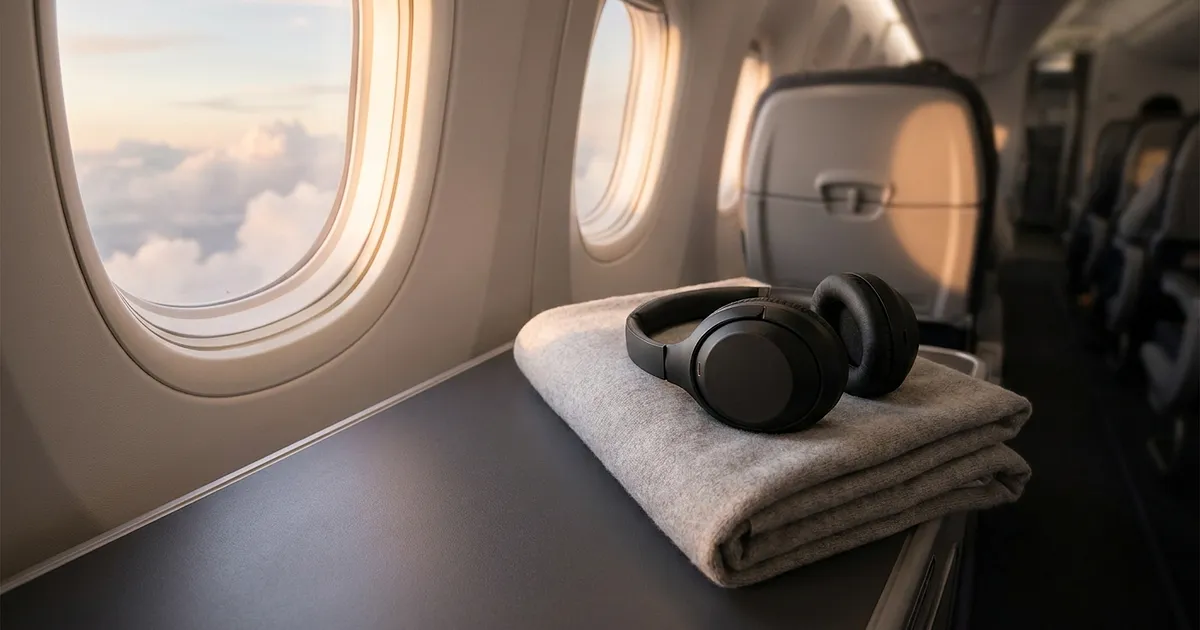
You are in the window seat, the plane starts its takeoff roll, and that deep engine drone chews through everything. That moment is exactly where your noise-cancelling headphones for flights earn their price or don't. The right pair turns a ten-hour long-haul into something you could almost call relaxing. The wrong pair sits in your carry-on and annoys you more than it helps.
There is no shortage of "best headphones" lists out there. Almost none of them actually factor in the flight itself: the noise, the adapter question, sleeping upright in a seat. That is what we do here.
Are Headphones Even Allowed on a Plane?
Short version: yes. But two myths refuse to die.
The first one is about Bluetooth. Plenty of people still think wireless headphones are banned onboard. Since the FAA rule change in 2013, you can use Bluetooth headphones in airplane mode throughout the entire flight, as long as the cellular connection stays off. The same applies in Europe. So you switch on airplane mode, turn Bluetooth back on, pair your headphones, and you are set.
The second myth: "headphones are off-limits during takeoff and landing." That is not true as a blanket rule, though there is a real kernel to it. According to EASA, corded headphones in particular are the issue during takeoff and landing, because the cable becomes a trip hazard in an evacuation and it makes crew safety announcements harder to hear. So it is not about radio interference at all. It is about your safety in the aisle. When the crew asks you to take your headphones off for takeoff, that is the reason.
In practice that means wireless in-ears, which barely stand out and never trail a cable across the row, are the least fiddly option onboard.
How Well Does Noise Cancelling Actually Work Against Plane Noise?
This is where it gets interesting, because plane noise is almost the ideal case for active noise cancelling.
ANC works through counter-sound. Tiny microphones measure the ambient noise, and the headphone generates an exactly mirrored sound wave that cancels it out. That works best on steady, low tones. As SoundGuys explains, constant low-frequency sounds like the hum of a jet engine are far easier to filter out than sudden, high-pitched ones. A jet engine hums steadily in the range of roughly 100 to 400 Hz. That is precisely what ANC is built for.
And the noise is real. A measurement published in Canadian Acoustics found continuous cabin levels of 80 to 85 dB(A) at cruise, with individual peaks up to 88 dB(A). For context: the US agency NIOSH cites 85 dBA averaged over eight hours as the threshold where workplace noise becomes a concern. So a long-haul flight sits right in that band. No reason to panic, but a good reason to treat your ears kindly.
What ANC cannot do is deliver absolute silence. Hearing Review published a study in which an ANC headphone reduced an 85-dBA test tone by 13.3 dB. Noticeably quieter, sure. But not dead silent. The crying baby two rows back and the rattling drinks cart stay audible, because those are exactly the sudden, high-pitched sounds ANC struggles with. Anyone who boards expecting total silence will always be let down.
One more myth that lingers: that ANC damages your hearing. There is no evidence for that. According to Shokz, the problem is not the noise cancelling itself but volume and listening duration. The rule of thumb is 60/60: no more than 60 percent volume, and a short break every 60 minutes. Ironically, ANC actually helps here, because with less ambient noise you can listen at a lower volume.
In-Ear or Over-Ear for a Flight?
This is the question people split on. And honestly, there is no clear winner, only trade-offs.
Over-ear headphones wrap fully around your ear. That adds a second, passive sound barrier on top of the ANC, and they stay comfortable for hours without loading up your ear canal. The catch: they are bulky in a carry-on, they press against a neck pillow or the window wall, and sleeping on your side with them on is nearly impossible.
In-ears disappear into a jacket pocket. They are light, you can rest your head sideways and still wear them, and for side sleepers they are often the only realistic option. In return, everything depends on the right ear tip. If the tip does not seal, it is not just the isolation that suffers but the ANC too, because the two work together, not against each other.
Rough guidance:
Shorter flights, lots of movie watching, maximum quiet: over-ear.
Carry-on minimalists and anyone who wants to sleep upright: in-ear.
Frequent flyers who genuinely need both: one good over-ear pair plus cheap in-ears for sleeping. It sounds like buying twice, but it is the most honest advice.
Top Picks: Noise-Cancelling Headphones Compared for 2026
Now for the actual models. We have not worn these headphones ourselves at 35,000 feet. We compared the features, the prices and the user ratings for use on a flight. Where we give an opinion, we say what it rests on.
For transparency: the prices below are a snapshot from amazon.de (as of 10 August 2026) and can fluctuate. If you buy through one of these links, we may earn a small commission. The price does not change for you.
| Model | Type | Price (as of 10 Aug 2026) | Rating |
|---|---|---|---|
| Anker Soundcore Space A40 | In-Ear | 49.99 € | 4.2 of 5 (23,876) |
| Anker Soundcore Liberty 4 NC | In-Ear | 79.99 € | 4.4 of 5 (27,564) |
| Sennheiser Momentum 4 Wireless | Over-Ear | 185.49 € | 4.3 of 5 (3,419) |
| Sony WH-1000XM5 | Over-Ear | 207.46 € | 4.4 of 5 (2,315) |
| Bose QuietComfort Ultra Earbuds | In-Ear | 214.39 € | 4.0 of 5 (2,982) |
| Bose QuietComfort Ultra Headphones | Over-Ear | 279.00 € | 4.2 of 5 (10,002) |
Budget Entry: Anker Soundcore Space A40
If you don't want to spend much but still want real ANC, this is the starting point. For 49.99 euros you get in-ears with active noise cancelling that, on paper, punch well above their price class. More than 23,000 ratings at a 4.2-star average is a strong signal in this segment.
For flying, the mix of small format and long battery life is the selling point. Don't expect Bose-level silence, that would be unfair. But as a first ANC experience, or as a backup pair for sleeping, the A40 does little wrong.
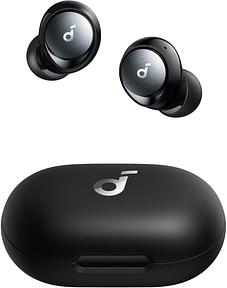
Soundcore by Anker Space A40 Kabellose Earbuds mit ANC
View at AmazonAffiliate link. Buying through it earns us a commission; the price stays the same for you.
The Value Pick: Anker Soundcore Liberty 4 NC
Thirty euros more, noticeably more headphone. For many travellers the Liberty 4 NC hit the sweet spot: stronger ANC than the A40, a comfier fit, and at 4.4 stars from over 27,000 ratings, the best-rated in-ears in this comparison.
At 79.99 euros this is, in our view, the most sensible choice if you want in-ears for the plane and don't feel like spending the maximum. The clamping force is low enough for sleeping, and the ANC dampens the engine hum well. Does it really need to be more than this? For most people, no.
Soundcore by Anker Liberty 4 NC Kabellose Earbuds mit Noise Cancelling
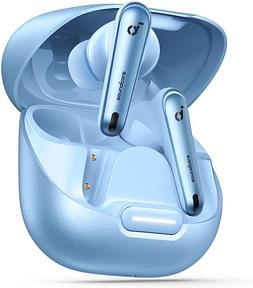
Soundcore by Anker Liberty 4 NC Kabellose Earbuds mit Noise Cancelling
View at AmazonAffiliate link. Buying through it earns us a commission; the price stays the same for you.
Over-Ear Classic With Stamina: Sony WH-1000XM5
Among over-ears, one name has been unavoidable for years. The Sony WH-1000XM5 is treated as one of the strongest ANC references on the market, and its 4.4 stars from over 2,300 ratings line up with what review desks keep giving it.
For 207.46 euros you get very good noise cancelling, a comfortable fit for long stretches, and a battery that clears an intercontinental flight easily. If you fly often and long and prefer over-ear, this is the pair everyone else has to measure up against.
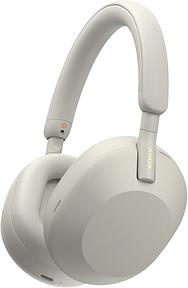
Sony WH-1000XM5 kabellose Noise-Cancelling-Kopfhörer
View at AmazonAffiliate link. Buying through it earns us a commission; the price stays the same for you.
Comfortable on Long-Haul: Sennheiser Momentum 4 Wireless
The Sennheiser Momentum 4 is the quiet insider tip among over-ears, and at 185.49 euros the cheapest way into the upper class here. Its reputation: a balanced, natural sound and a battery life that makes even Sony and Bose look ordinary. For frequent flyers who hate hunting for a charging cable, that is a real argument.
Its ANC sits a notch behind Sony and Bose, but it wears light and doesn't press even after hours. 4.3 stars from over 3,400 ratings. If you put comfort and runtime above the last few percent of silence, this is your pick.
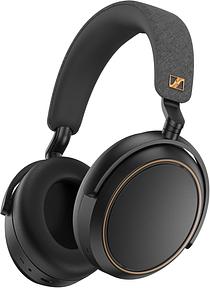
Sennheiser Momentum 4 Wireless Noise Cancelling Kopfhörer
View at AmazonAffiliate link. Buying through it earns us a commission; the price stays the same for you.
Premium In-Ear: Bose QuietComfort Ultra Earbuds
Bose has long built some of the quietest headphones anywhere, and the QuietComfort Ultra Earbuds bring that skill to the in-ear format. For 214.39 euros you get the quiet of an over-ear in an earbud that fits in your trouser pocket. For side sleepers on long-haul, that is worth a lot.
Honestly though: the price is steep for in-ears, and at 4.0 stars from just under 3,000 ratings, satisfaction is a touch more mixed than with the Anker rivals. But if you want the best ANC in the smallest format and you sleep upright, there is barely a better option.
Bose QuietComfort Ultra Earbuds (2. Gen.) mit Noise Cancelling
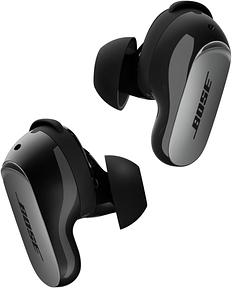
Bose QuietComfort Ultra Earbuds (2. Gen.) mit Noise Cancelling
View at AmazonAffiliate link. Buying through it earns us a commission; the price stays the same for you.
Premium Over-Ear and Best Silence: Bose QuietComfort Ultra Headphones
If absolute quiet on a flight is your only criterion, this is where the road ends. The Bose QuietComfort Ultra Headphones are treated as the benchmark for noise cancelling. At 279.00 euros it is the priciest model in the comparison, but 4.2 stars from over 10,000 ratings show that people get what they pay for.
On a loud red-eye, the gap to cheaper models is most obvious. The engine almost vanishes, and the fit stays comfortable for hours. Expensive? Sure. But if you cross the Atlantic twelve times a year, quiet pays for itself faster than you would think.
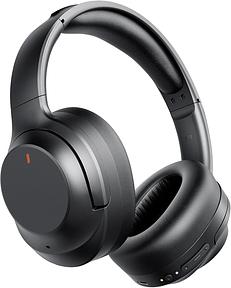
Not available in your region — closest match
View at Amazon (as of Aug 15)Affiliate link. Buying through it earns us a commission; the price stays the same for you.
Do I Need an Adapter for My Headphones on the Plane?
This is the point where pricey headphones suddenly look useless onboard, and almost no guide mentions it.
Many older aircraft have a screen in the seat with an odd socket: two plugs side by side, a so-called dual-prong connector. Your normal 3.5 mm jack won't fit. You need a small adapter that turns two pins into a single jack. Cost: usually under ten euros. Bring one if you want to watch the movies on the seatback screen.
And with Bluetooth headphones? Those won't pair directly with an old seatback screen. For that there are small Bluetooth transmitters you plug into the jack or dual-prong socket, which then connect your wireless pair. A bit of fiddling, but it works.
The good news: newer planes are catching up. Some cabins now have USB-C right at the seat, and airlines like Delta and United are upgrading their entertainment systems to direct Bluetooth pairing. Until that becomes the norm, though, it will be years. For 2026 the rule still holds: a headphone adapter costs almost nothing and can save half your flight. Into the carry-on it goes.
Bottom Line: Which Headphones Are Worth It for Flying?
There is no single right headphone, only the right one for your travel style. If you want to pack small and sleep upright, go for good in-ears like the Anker Liberty 4 NC or, if the budget allows, the Bose Ultra Earbuds. If maximum quiet on long stretches is all that counts, the Sony WH-1000XM5 or the Bose Ultra Headphones are the safe bet. And if you just want to test whether ANC is even for you, the 50-euro Anker does nothing wrong.
Don't forget the headphone adapter. It costs next to nothing and saves the movie when the seatback screen is once again stuck in the past.
Headphones are only one part of an easy long-haul anyway. Just as important: being online the moment you land, without a roaming shock. How you sort that with an eSIM is what our eSIM comparisons are for. Airplane mode first, then abroad mode.
All products from this post
The ones we named above are marked; the rest are alternatives in the same category.
Affiliate notice: As an Amazon Associate, we earn from qualifying purchases. Product prices and availability are subject to change.
Frequently Asked Questions
Are Bluetooth headphones allowed on a plane?
Yes. Since 2013, Bluetooth headphones have been allowed in airplane mode throughout the entire flight, as long as the cellular connection stays off. You switch on airplane mode and turn Bluetooth back on afterwards. During takeoff and landing some airlines ask you to take your headphones off so you can hear the safety announcements.
How much quieter do noise-cancelling headphones really make a flight?
A lot quieter, but not silent. A measurement with an ANC headphone found around 13 dB of reduction on an 85-dBA test tone. The steady engine hum gets strongly dampened, while sudden sounds like voices or the drinks cart stay audible. Anyone expecting total silence will be disappointed.
Does noise cancelling damage your hearing?
No, there is no evidence for it. The noise cancelling itself is not the problem, but volume that is too high for too long. As a rule of thumb, follow 60/60: no more than 60 percent volume and a short break every 60 minutes. ANC actually helps, because with less ambient noise you can listen at a lower volume.
In-ear or over-ear: which is better for long flights?
Both have upsides and downsides. Over-ears usually dampen noise a little better and stay comfortable for hours, but they are bulky and poor for sleeping on your side. In-ears pack smaller, suit sleeping upright, and depend heavily on the right ear tip. For long-haul in a seat, in-ears often win.
Which adapter do I need for headphones on a plane?
Many older seatback screens have a dual-prong socket with two pins that no normal jack fits. For that you need a small adapter costing under ten euros. With Bluetooth headphones, a Bluetooth transmitter for the seat socket does the job. Newer planes sometimes offer USB-C or direct pairing, but that is not yet standard.