RFID Blockers & Sleeves for Travel: The Honest 2026 Test
 14 min read
Right before my last flight, someone at the gate told me thieves could read my credit card as they walked past. Sounded terrifying. So I sat down and worked out what an RFID blocker actually does on a trip, instead of trusting the copy on the packaging. The answer turned out to be surprisingly calm.
And that is what this guide is about. No panic-selling. Just an honest look at the numbers, the passport question, the real risks at the airport, and whether you need to buy anything at all.
How big is the risk, really?
Let's start with the part most guides skip, because they are trying to sell you an RFID blocker at the end. How many people actually got robbed because someone read their card contactlessly?
The honest answer: there are basically no known cases. Germany's Federal Criminal Police Office told Stiftung Warentest it has no corresponding case figures. The technical hurdles for this kind of data theft are high, it said, and the practical relevance is low. That is why the police don't even track RFID skimming as a category of its own.
The German banking association says the same thing. Asked by Stiftung Warentest, it replied plainly: "We are not aware of any cases of damage." Two institutions that otherwise agree on little, the police and the banks, reach the same conclusion.
And internationally? The UK Finance Fraud Report 2025 puts contactless-payment fraud losses at roughly 1.2 pence per 100 pounds spent, for 2025. That is the lowest rate of any card-fraud type, and it actually fell slightly year on year. A second country, the same finding.
None of this means the tech doesn't work. It just means the harm you are trying to protect against almost never happens in real life.
How RFID works, and how close someone would need to get
Contactless cards and the ePassport transmit on 13,56 MHz. The range of that technology is the whole crux, because this is where marketing parts ways with physics.
You have probably read somewhere that a thief can read your card from three metres away. Security expert Rudolf Linsenbarth called that claim physically impossible in an interview with IT Finanzmagazin. His line about it is wonderfully dry: anyone who could generate a field three metres wide with a smartphone would be "the next candidate for the Nobel Prize in Physics."
So what is the real range? The spec allows up to 10 cm. Actual payment terminals usually read under 4 cm, and a smartphone barely gets past 2 cm in practice. And the moment your card sits in a wallet next to coins or a second card, reading becomes, in Linsenbarth's words, "almost impossible."
Picture it concretely. Someone would have to bring a reader within a couple of centimetres of your pocket, in a queue, without you noticing, and would then get a jumble of data if several cards are stacked together. Not impossible. But a long way from the casual walk-by in the ad.
What data actually gets transmitted
Even if the read succeeds, what does the attacker actually get?
Less than you'd think. According to Finanztip, a contactless payment transmits only the card number, the expiry date and a single-use cryptogram. Not the CVV security code on the back. Not your name. Not your address. And never the PIN over the air. American Express frames NFC sleeves just as soberly and spells out which data really moves.
With a card number and expiry date alone, a fraudster can't get through most online shops, because those ask for the CVV. The single-use code is good for exactly one transaction, too. That is why the theoretical data theft is worth so little.
One detail for travellers: amounts above the small-payment limit (usually between 25 and 50 euros, depending on the bank) require the PIN at the terminal anyway, not contactlessly.
RFID protection for your passport: do you need it at the border?
This is the question travellers really worry about, more than the credit card: is an RFID blocker even worth it for a passport? Can someone scan my passport while it sits closed in my backpack?
Short version: no, not just like that. The electronic passport uses several security mechanisms against unauthorised chip reading, according to the BSI. The key one is an access procedure that requires the printed data page to be optically scanned first. In practice that means the passport has to lie open in front of a scanner before the chip responds at all. Closed in your bag, it stays silent.
That undercuts the whole "someone secretly scans your passport at the airport" story that a lot of passport-cover marketing rests on. A shielding passport cover is therefore more belt-and-braces caution than a fix for a real gap.
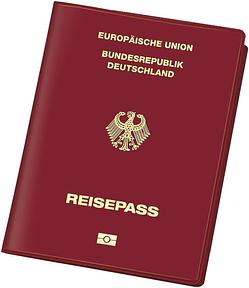
If you still want one, because it reassures you or because you want to protect the passport from bending and moisture anyway, that is perfectly fine. At 13.71 euros, as of August 2026 (amazon.de), the VELOFLEX - Reisepasshülle Document Safe 100 x 135 mm, Weinrot | RFID/NFC-Schutz, aus PVC und Spezialfolie, passend für ePass mit RFID-Funkchip, schützt persönliche Daten gets you a plain passport cover with RFID/NFC shielding, in burgundy, sized for the ePassport, rated 4.4 out of 5 stars from 228 ratings.
Affiliate link. Buying through it earns us a commission; the price stays the same for you.
RFID protection on the road: the travel scenarios, honestly
Instead of blanket panic, here are the places travellers worry about, each with an honest read on whether an RFID blocker actually helps there.
Airport security queue. Tight crowd, strangers close to you. Sounds like the perfect skimming moment. In reality someone would have to hold a reader steady, centimetres from your card, and would then get that near-useless data from above. The real risk here is the old-fashioned one: someone simply lifting the card or wallet out of your pocket.
Packed public transport abroad. Same picture. Pickpockets are the real story, not radio skimmers. A zipped wallet worn close to your body helps against both far more than any shielding.
Hotel room and safe. Hotel key cards often use RFID themselves. Your bank card sitting next to one in the safe does not get read because of it, that is a myth. Nothing happens here at all.
Hostel dorm. Strangers, open lockers, your bag unattended. That, too, is a theft problem, not a radio one. Carrying valuables on your body beats any sleeve.
Notice the pattern? On a trip the hand in your pocket is the risk, not the invisible antenna. Which is exactly why some RFID travel products are still worth it: not for the shielding, but because they keep your things close to your body and hard to reach.
The products compared
I didn't measure this selection in a lab. I put it together from ratings, features and travel fit. The prices and stars are a snapshot, as of August 2026 (amazon.de), and they change constantly.
| Product | Type | Price | Rating | Best for |
|---|---|---|---|---|
| TÜV-tested card sleeves (12-pack) | Card sleeve | 11.95 € | 4.4 ★ (14,277) | Cheap start, whole family |
| CardTresor stainless-steel sleeves | Card sleeve (metal) | 11.90 € | 4.6 ★ (452) | Durable sleeve, Made in Germany |
| TRAVANDO SLYDE card holder | RFID wallet | 34.95 € | 4.3 ★ (2,680) | Daily & travel, few cards |
| VELOFLEX passport cover | Passport cover | 13.71 € | 4.4 ★ (228) | ePassport, plain protection |
| Family passport organizer | Document pouch | 22.92 € | 4.7 ★ (138) | Several passports & tickets |
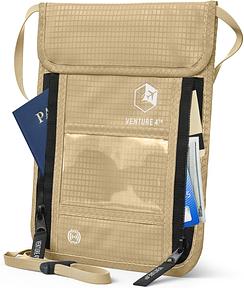
| Neck wallet with RFID protection | Neck wallet | 7.59 € | 4.4 ★ (342) | Valuables on your body |
RFID card sleeves: the cheap start
If you buy anything at all, start here. An RFID sleeve for individual cards costs almost nothing, weighs nothing and fits any wallet. The TÜV geprüfte RFID Blocker NFC Kartenhülle | 12 Schutzhüllen für Kreditkarte, EC Karte, Bankkarte & Reisepass | Scheckkartenhülle Kreditkarten Schutzhülle comes as a twelve-pack, TÜV-tested, for 11.95 euros, as of August 2026 (amazon.de). At 4.4 out of 5 stars from over 14,000 ratings, it is the most-bought entry point, and one set covers the whole family plus a passport.
A step up in quality and sturdiness is the metal version. The CardTresor zertifizierte RFID NFC Edelstahl Schutzhüllen | 100% Schutz für Kreditkarten, EC Karten, Ausweis & Co. | Passgenauer Card Blocker/Schutz gegen Datenklau | Made in Germany from CardTresor is made of stainless steel, "Made in Germany," and rates even higher at 4.6 out of 5, for 11.90 euros, as of August 2026 (amazon.de). If you want a sleeve that won't go floppy in your wallet after a few weeks, this is the one.
Honestly, one of these two is plenty for 95 percent of travellers. Everything beyond it is comfort, not more safety.
Not available in your region — closest match
VENTURE 4TH Travel Neck Wallet, RFID Blocking Passport Holder - Beige
View at Amazon (as of Aug 15)Affiliate link. Buying through it earns us a commission; the price stays the same for you.

Affiliate link. Buying through it earns us a commission; the price stays the same for you.
RFID wallet and card holder
Instead of separate sleeves, you can go straight for an RFID wallet with the shielding built in. That is more of a daily-carry decision than a security one, but it is handy on trips, because a slim holder draws less attention and tucks away faster.
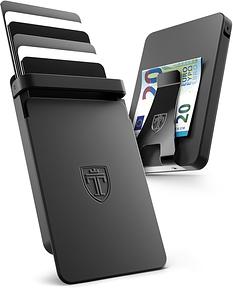
If you carry few cards and want a rigid case instead of a soft sleeve, the TRAVANDO SLYDE Aluminium Kartenetui mit RFID Schutz - Kartenhalter mit Geldklammer für 9 Karten - Kreditkartenetui Portmonee Herren Slim Wallet (8-9 Karten) fits the bill: an aluminium card holder with a money clip and RFID protection for up to nine cards, 34.95 euros, as of August 2026 (amazon.de), at 4.3 out of 5 stars from around 2,680 ratings. It costs a lot more than a card sleeve, but you get a rigid shell that also protects the cards physically. For frequent travellers with few cards, a clean choice. If you need a fat wallet with twenty cards and coins, this isn't it.
Affiliate link. Buying through it earns us a commission; the price stays the same for you.
Passport and documents for the family
Travelling with kids or a partner, and managing passports, tickets and boarding passes turns into chaos fast. A document pouch solves the organisation problem and brings the shielding along for the ride.
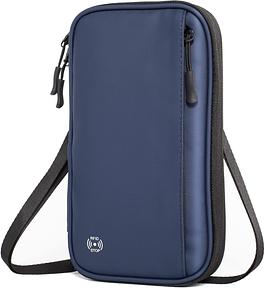
That's exactly where the Reisepass Tasche Familie Reiseorganizer, RFID Blocker Ausweistasche | Faltbare Reisepasshülle für Damen Herren, Schutzhülle für Flugtickets, Kreditkarten/Ausweis, Tragbare Dokumententasche comes in: a foldable travel organizer with an RFID blocker that bundles several passports, flight tickets and cards, 22.92 euros, as of August 2026 (amazon.de). At 4.7 out of 5 stars it has the highest rating in the whole comparison, though from just 138 reviews so far. Its real value is order at passport control; the shielding is the bonus on top.
Affiliate link. Buying through it earns us a commission; the price stays the same for you.
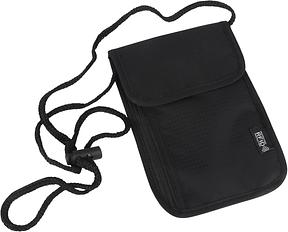
Neck wallet: valuables close to your body
And then there is the option that helps most in actual travel, because it addresses the real risk: theft. A neck wallet under your shirt is simply out of reach for a pickpocket.
The Brustbeutel mit RFID Schutz, Reisegeldbeutel, Weicher Brustbeutel zum Reisen Unisex, versteckte Anti-Diebstahl Festival Passhalter für Passport, Kreditkarten, Münzen und Reise Zubehör (Schwarz) costs only 7.59 euros, as of August 2026 (amazon.de), holds a passport, cards and some cash, and adds RFID protection on top, at 4.4 out of 5 stars from 342 ratings. For long train rides, packed markets or night buses it is my personal favourite. The radio shielding is a bonus. The point is that nobody gets to it unnoticed.
Affiliate link. Buying through it earns us a commission; the price stays the same for you.
What an RFID blocker does NOT protect you from
This is the section no ad likes to write. A sleeve blocks radio. Full stop. Against the fraud methods that are actually common, it does nothing:
Phishing. The fake text from your "bank" or "delivery company" on your phone. No sleeve on earth helps.
Skimming at a tampered terminal or ATM. The classic, where the magstripe and PIN are grabbed right at the device.
Online (card-not-present) fraud. If your data comes from a hacked shop, the radio chip is completely uninvolved (that one gets you sitting on your couch, not standing at the gate).
App and account takeovers. Those run through passwords and logins, not the surface of your card.
Plain theft of the card or wallet.
On a trip, other habits pay off more: cover your PIN, keep an eye on your account through the app, be careful on unfamiliar Wi-Fi. If you do online banking on hotel Wi-Fi, a VPN for travel protects you far more effectively than any card sleeve. And if you want to be online abroad safely and without the roaming trap in the first place, an eSIM for abroad beats expensive data roaming.
Free instead of bought: what you already have
Before you order anything, check your drawer. Many German banks already include an RFID sleeve with the card mailing, and the ADAC hands them to members too. If you have one, you're done, there is no technical difference between the free sleeve and a bought one.
Cheaper still: back in 2013, Stiftung Warentest found that plain kitchen foil achieves RFID shielding of 50 to 60 dB, a signal reduction of about 99 percent. Physically, that is more than enough. It just doesn't look as neat in your wallet.
Just to put the whole topic in perspective: according to polizei-beratung.de, the number of fraud cases with payment cards used without a PIN rose from 15,170 in 2024 to 16,630 in 2025. But the German crime statistics don't break out a separate RFID category at all, which fits the police statement neatly: barely relevant in practice.
Conclusion
After all the numbers, one impression stands out: RFID skimming is a real piece of technology, but a travel risk that almost never strikes in everyday life. Two authorities and two banking bodies across two countries find no real cases, and even a successful read yields barely usable data.
So my advice: if your bank gave you a sleeve, use it and move on. If not, an RFID blocker in the form of a plain card sleeve costs so little you can happily pack one, just don't expect more than a good feeling in return. Put your energy into the protection that really counts on the road: valuables close to your body, a covered PIN, and a safe way to get online abroad. The rest is marketing.
All products from this post
The ones we named above are marked; the rest are alternatives in the same category.
Not available in your region — closest match
VENTURE 4TH Travel Neck Wallet, RFID Blocking Passport Holder - Beige
View at Amazon (as of Aug 15)
Affiliate notice: As an Amazon Associate, we earn from qualifying purchases. Product prices and availability are subject to change.
Frequently Asked Questions
Does an RFID blocker actually work?
Yes, the shielding works technically. Stiftung Warentest confirmed back in 2013 that a simple blocker cuts the radio signal by about 99 percent. The more honest question is whether you need it: Germany's federal police and banking association know of no documented fraud cases from RFID skimming. The sleeve works, the problem is just rare.
Do I need an RFID sleeve for my passport?
Usually not. The electronic passport only releases its chip data once the printed data page has been optically scanned, according to the BSI. A closed passport in your bag therefore can't be scanned secretly. A shielding cover is nice extra caution and good bend-and-moisture protection, but not a must at the border.
Can I get an RFID sleeve for free?
Often yes. Many German banks include an RFID sleeve with new cards, and the ADAC gives them to members. Technically the free sleeve shields just as well as a bought one. So check your paperwork before you spend money.
Can I make RFID protection myself with kitchen foil?
Yes. Stiftung Warentest measured shielding of 50 to 60 dB with plain foil, about 99 percent less signal. Physically that is plenty. It just doesn't look particularly elegant in a wallet and wears out faster than a solid sleeve.
What does an RFID blocker not protect against?
The most common types of fraud. Phishing texts, skimming at tampered terminals, online fraud with stolen data, app takeovers and plain pickpocketing all stay untouched by a sleeve. On a trip, covering your PIN, checking your account through the app and being careful on unfamiliar Wi-Fi add far more real security.