Travel Cable Organizer Bags: The 2026 Test
 14 min read
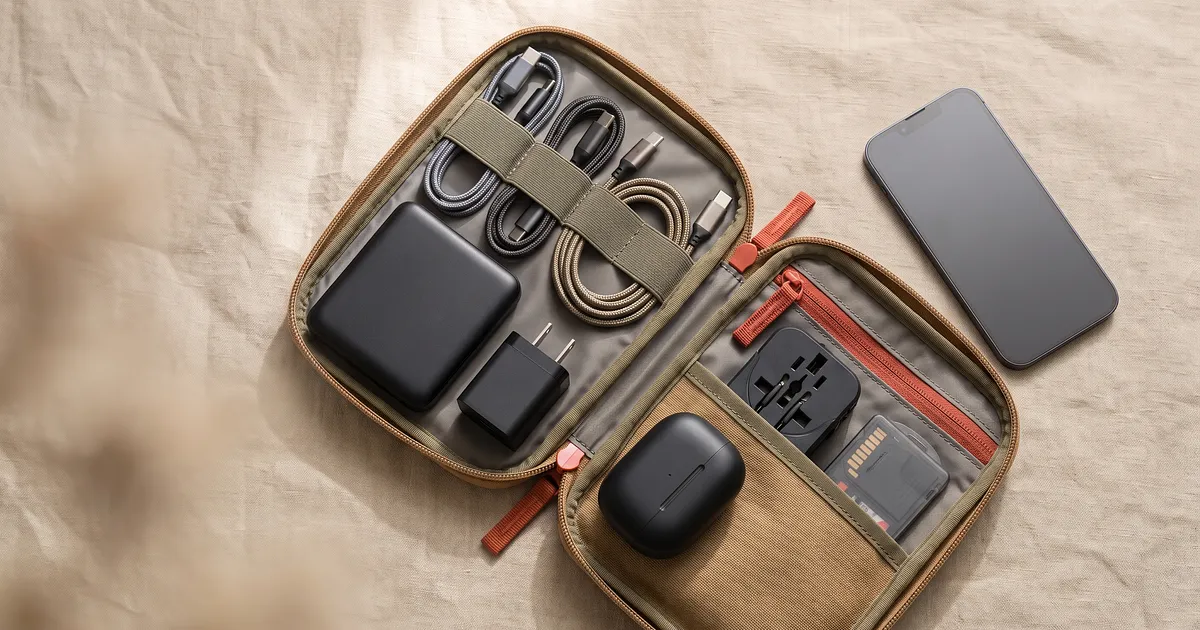
Anyone who has spent five minutes digging around a backpack at the gate for the right charging cable knows the pain. A good cable organizer fixes exactly that. One grab, everything there, nothing tangled. Sounds trivial, but on a multi-stop trip or a tight connection it's the difference between calm and irritated. And in 2026 there's a second reason to look closer: the tightened power bank rules on planes. More on that below.
I'll say it up front: there's no such thing as the "perfect" bag, only the right one for your kit. A digital nomad with a hub and an external drive needs something different from someone stashing two cables and earbuds. So I've sorted the five models below not from "good to bad" but by what you actually haul around.
What a good cable organizer really needs in 2026
Start with the pockets, not the price. As Forbes Vetted sums it up, three things basically decide a cable organizer: compartment layout, material, and size. The rest is taste.
With the pockets, the mix matters more than the count. A few elastic loops for cables, a zippered mesh pocket for small stuff like SD cards or the SIM eject tool, and a padded compartment for the power bank. That padded, separate compartment is no longer a luxury in 2026, it's a real buying criterion. Why, in a second.
Material: nylon or polyester with a water-repellent coating is more practical on the road than leather. Looks less fancy, but survives a spilled coffee at the airport. Felt and leather exist as premium options, cost more, and protect worse when things get wet.
Size: this is where people buy wrong most often. A bag that looks generous on your desk at home quickly blows past the small carry-on allowance. Measure once before you order.
Boiled down: you want order, protection from moisture, and a format that still fits your carry-on alongside a backpack or trolley. Everything else is a bonus.
The 5 models compared
I lined up five organizers from the German Amazon range, from the slim budget pouch to the double-layer all-rounder. All prices and ratings are Amazon figures as of 2026, and they shift, of course. Take them as a guide, not gospel.
| Model | Type / Size | Price (as of 2026) | Amazon rating (as of 2026) | Best for |
|---|---|---|---|---|
| Bagsmart Mini | slim cable pouch | €12.99 | 4.7 of 5 (354 reviews) | minimalists, second pouch |
| Bagsmart Organizer | classic electronics organizer | €17.99 | 4.6 of 5 (914 reviews) | standard travel kit |
| Tomtoc EDC | water-resistant tech pouch | €16.99 | 4.8 of 5 (3,302 reviews) | frequent travelers, outdoors |
| UGREEN Organizer (L) | large two-part organizer | €19.99 | 4.6 of 5 (8,279 reviews) | lots of gear, tablet |
| Bagsmart XL | double-layer, up to 10.5-inch iPad | €27.99 | 4.6 of 5 (351 reviews) | laptop charging kit, family |
Budget: small, light, cheap
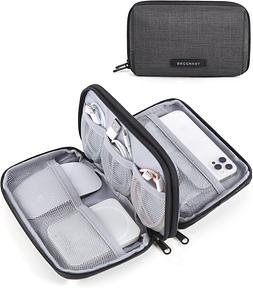
If you only need to stash a phone cable, earbuds, and a small plug, you don't need a big organizer. The BAGSMART Cable Bag Organiser Travel Bag for Electronics Organiser Waterproof Accessories for Mobile Phone Charging Accessories, Black is one of those slim cases.
For roughly €13 (Amazon, as of 2026) you get a flat, water-repellent pouch that slips into any backpack front pocket. The 4.7-star rating from 354 reviews is solid for a budget product. Don't expect a padded power bank compartment or thick cushioning. This is a second pouch for people who travel light, not an all-in-one package. For weekend trips it's often plenty.
Affiliate link. Buying through it earns us a commission; the price stays the same for you.
The all-rounder for a normal travel kit
For most people the answer sits here. The Bagsmart Electronics Organiser for Cables, USB Sticks, Memory Cards is the classic electronics organizer: one main compartment, lots of small dividers, elastic loops for cables, mesh pockets for SD cards and USB sticks. 914 reviews at 4.6 stars (Amazon, as of 2026), and at €17.99 still cheap.
The blogger at PhinéTravels describes exactly this kind of kit: a one-meter USB-C cable for phone and laptop, a short cable for the earbuds, a compact 10,000 mAh power bank, and a small dual-USB plug. A typical holiday trip needs no more than that. And everything has a fixed spot.
Want it tougher and water-resistant? Take a look at the tomtoc Elektronik Organizer Tasche, Wasserresistent EDC Zubehör Kabeltasche, Tragbar Kabelorganizer Tech Pouch Bag für Handy Netzteil, Ladekabel, Ladestecker, Powerbank, Festplatte, Schwarz. At 4.8 stars from more than 3,300 reviews (Amazon, as of 2026) it's the best-rated candidate in the lineup, yet costs only €16.99. The water-resistant shell makes it a good companion for road trips or countries where a downpour catches you on the platform. To me the most well-rounded pick of the five if you're torn between two models.
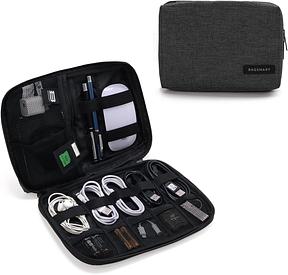
Bagsmart Electronics Organiser for Cables, USB Sticks, Memory Cards
View at AmazonAffiliate link. Buying through it earns us a commission; the price stays the same for you.
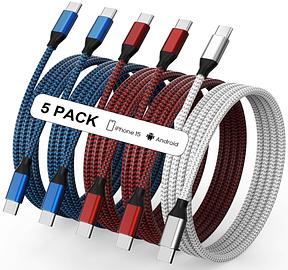
Not available in your region — closest match
View at Amazon (as of Aug 15)Affiliate link. Buying through it earns us a commission; the price stays the same for you.
When more has to fit: the large organizers
The moment a tablet, a laptop power brick, or an external SSD comes into play, the small pouches get tight. Two candidates for that weight class.
The UGREEN Electronics Travel Cable Bag, Portable Cable Organiser Bag (L), Two-part electronics accessories case for cables, charger, power bank, tablet is a large, two-part organizer with a huge review base: over 8,200 reviews at 4.6 stars (Amazon, as of 2026). Two fold-open sides, plenty of room for cables, charger, power bank, and a small tablet. €19.99. If you're bundling the charging gear for a whole family, this one has you covered.
One size up again: the bagsmart Cable Bag, Double Layer Electronic Organiser Travel Electronic Bag for Cable, Charger, iPad up to 10.5 Inches, Adapter, Mouse, SD Cards, Black.
Double-layer, holds a 10.5-inch iPad per the manufacturer, plus adapter, mouse, SD cards, and charging cables. €27.99, 4.6 stars from 351 reviews (Amazon, as of 2026). This is the bag for a full laptop charging kit, or for people who'd rather buy one size too big than twice too small. Digital nomads, per CabinZero, pack a USB-C hub and an external SSD on top of that anyway, and that's exactly the space you'll need.
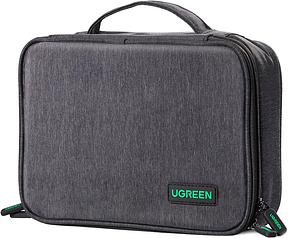
Affiliate link. Buying through it earns us a commission; the price stays the same for you.
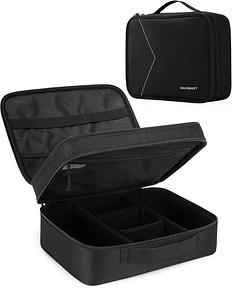
Affiliate link. Buying through it earns us a commission; the price stays the same for you.
Material, zippers and internal layout: what to check
Quick word on the build of the bag itself, because this is where the differences hide that a product photo never shows.
Material and weather protection. Nylon or polyester with a water-repellent coating is the standard, and for most people that's plenty. If you want to feel safe next to a water bottle in your backpack or out in the rain, look for the word "water-resistant" rather than just "water-repellent." Sounds like nitpicking, but it's real: repellent beads off briefly, resistant shrugs off a few splashes. Leather looks smart, but soaks through when wet and gets heavy. On the road I'd skip it.
Zippers. The part that breaks first. A solid zipper (on branded gear often YKK) still runs clean after a hundred openings, a cheap one snags after two weeks of travel. Two sliders on one compartment are handy, since you can open it from either side. And check for small pull tabs, or you'll be fumbling at the zipper in the half-dark at the gate. Sounds like a detail, but it bites exactly when you're in a hurry.
Internal layout. This is where order splits from chaos. Elastic loops hold cables and plugs in place instead of letting everything knot up. Zippered mesh pockets are for the small stuff that otherwise falls out: SD cards, USB sticks, the SIM tool. Transparent mesh has the bonus that you can see what's inside without opening every pocket.
The power bank compartment. The one detail that really matters in 2026. A separate, padded pocket protects the power bank from knocks, keeps it away from loose metal (short-circuit risk), and, very practically, you pull it out at security in two seconds. Ideal is a compartment that opens separately and holds at most one or two power banks. You don't want more than that under the current flight rules anyway.
Two example kits: which bag suits whom
The easiest way to choose is to lay your own gear on the table and see how much it actually is. Two setups I see again and again.
The weekend kit. Phone, a GaN charger (the little ones that push real wattage despite the tiny size), one or two USB-C cables, a compact 10,000 mAh power bank, and earbuds. That's it. The blogger at PhinéTravels describes exactly this set for her holiday trips. You don't need a giant organizer for that. A flat cable pouch like the Bagsmart Mini does the job, and if you want a bit more structure and mesh pockets, the classic Bagsmart Organizer. Both slip into a backpack front pocket, and you barely notice you're carrying them.
The frequent-traveler kit. Now it fills up. Laptop charger, two or three cables in different lengths, a large 27,000 mAh power bank (careful, that one already scrapes the 100 Wh carry-on limit), a USB-C hub, a few SD cards, and a travel adapter. That's the load digital nomads haul around per CabinZero. Here a small bag becomes a pain, because you keep unpacking everything to reach that one cable. A double-layer organizer like the Bagsmart XL or the large, two-part UGREEN Organizer swallows all of it. If your kit lands somewhere in between, the water-resistant Tomtoc EDC is the good middle ground.
And if you're unsure? Take the version for the bigger kit. A half-empty bag bothers nobody, an overstuffed one splits at the seams on day three. That's my experience, at least, after too many rounds of "it'll fit."
Power bank rules 2026: what it means for your cable organizer
Now the part the old cable-bag guides miss entirely. Since early 2026, stricter rules apply to power banks on board, and they also affect how your bag should be built.
According to the ADAC, the Lufthansa Group has allowed a maximum of two power banks up to 100 Wh in carry-on since 15 January 2026. Models between 100 and 160 Wh need airline approval, above 160 Wh they're out entirely. On top of that, power banks may no longer be used or charged on board. That applies group-wide, so Eurowings, Swiss, Austrian, and the rest too. Other airlines can differ, so check quickly before your flight.
And the international baseline? The IATA requires that power banks and spare batteries go in carry-on only, never in checked luggage. And they must be individually protected against short circuits: original packaging, taped contacts, or a dedicated compartment.
That's where the cable organizer comes in. A separate, padded power bank compartment isn't a nice extra anymore, it meets exactly this short-circuit requirement. Handy side effect: with the power bank in its own, easy-to-reach pocket, you don't have to dump out the whole bag at a security check. As a rough guide, a 10,000 mAh power bank sits well under the limit, and only around 27,000 mAh do you get near the 100 Wh mark.
Short version: pick a bag where the power bank sits isolated and within reach. It saves you hassle at the gate.
Does the organizer still fit your carry-on?
Most common mispurchase, from the practical side again. A cable organizer almost always goes into the small carry-on item, the so-called personal item, on top of a backpack or trolley. On Ryanair basic fares that's often just 40 by 30 by 20 centimeters.
Most cable organizers measure between 20 and 29 centimeters on the longest edge, so they fit easily. The real question is the space left over afterwards. A double-layer XL organizer eats more of that volume than a flat mini pouch. So don't just think about the bag itself, think about everything that has to sit next to it: water bottle, snacks, passport, headphones.
My rule of thumb: if you only have one personal item and a lot else has to go in, take the smallest bag that still fits your kit. If you've got an extra carry-on piece, you can be more generous.
What goes inside when you travel on an eSIM?
Quick detour to connectivity, since that's our beat. If you go online abroad on an eSIM instead of pricey roaming, you often travel without any physical SIM card at all. Even so, a small mesh pocket earns its place for the bits that otherwise vanish: the SIM eject tool (for the backup SIM or a second phone), a few SD cards, maybe a tiny USB stick with offline maps.
The eSIM market keeps growing, by the way: per Fortune Business Insights (as of July 2026) it's projected to reach around 7.6 billion US dollars by 2034. In practice that mostly means more travelers with less card clutter and more need for order among cables and adapters. If you're still wondering whether an eSIM is worth it for you, we run the numbers in our guide to the right eSIM for your destination.
My verdict
The honest answer to "which cable organizer?" is: the second-smallest one that fits your stuff. Too small is annoying, too big is too. For a normal travel kit, an organizer around €15 to €20 with a padded power bank compartment is the safe bet. If you haul a laptop and an SSD, reach for the double-layer XL. And if you only carry two cables, the mini pouch does it.
In 2026, watch for the one new detail: a separate, padded compartment for the power bank. It's half order, half regulation now. Your nerves at the gate will forgive the rest.
Pack smart and you'll have more time for the actual trip. And if you haven't sorted your connection abroad yet, take a look at our eSIM comparison before you fly.
All products from this post
The ones we named above are marked; the rest are alternatives in the same category.
Not available in your region — closest match
USB C to USB C Cable Nylon Braided 60W 3/3/6/6/10 FT USB Type C Fast Charging Cable for iPhone 17/17 Pro Max/Air/16/16 Plus/16 Pro Max/15/15 Plus/15 Pro Max, MacBook, iPad, Samsung S25/S24/23 | USB Type C for iPhone 17/17 Pro Max/Air/16/16 Plus/16 Pr
View at Amazon (as of Aug 15)
Affiliate notice: As an Amazon Associate, we earn from qualifying purchases. Product prices and availability are subject to change.
Frequently Asked Questions
What should go inside a travel cable organizer?
For most trips a one-meter USB-C cable for phone and laptop, a short cable for the earbuds, a compact 10,000 mAh power bank, and a small dual-USB plug will do. Add SD cards, a USB stick, and the SIM eject tool in the mesh pockets. Frequent travelers often pack a USB-C hub and an external SSD too. What matters is less the quantity than that everything has a fixed spot and is quick to find.
What size cable organizer fits in carry-on?
Almost any. Most cable organizers measure between 20 and 29 centimeters on the longest edge and slip easily into the small personal item, which on Ryanair basic fares is often 40 by 30 by 20 centimeters. More important than the bag itself is the space left beside it. Factor in your water bottle, passport, and snacks, and when in doubt take the smaller version.
Can the power bank go in the cable organizer?
Yes, and it actually must travel in carry-on, never in checked luggage. It has to be individually protected against short circuits, and a separate padded compartment in the cable organizer does that well. With the Lufthansa Group, since January 2026 a maximum of two power banks up to 100 Wh are allowed, between 100 and 160 Wh only with approval, above that not at all. It can no longer be charged on board.
Cable organizer or packing cube: what's the difference?
A packing cube is a rectangular fabric pouch for clothing, with no internal divisions. A cable organizer is an electronics organizer with loops, mesh pockets, and padding made specifically for cables, chargers, and power banks. A packing cube is unsuitable for tech because nothing is held in place and everything tangles. The cable organizer, in turn, is too small for clothes. They complement each other but don't replace each other.
What material should a cable organizer be?
For travel, nylon or polyester with a water-repellent coating is most practical. It's light, tough, and shrugs off splashes or a tipped-over cup. Leather and felt look classier, cost more, and protect worse when wet. If you're often outdoors, look for an explicitly water-resistant version. For pure in-suitcase use, a simpler padded model is enough too.