Universal Travel Adapter 2026: Test & Buying Guide for Connected Travelers
 14 min read
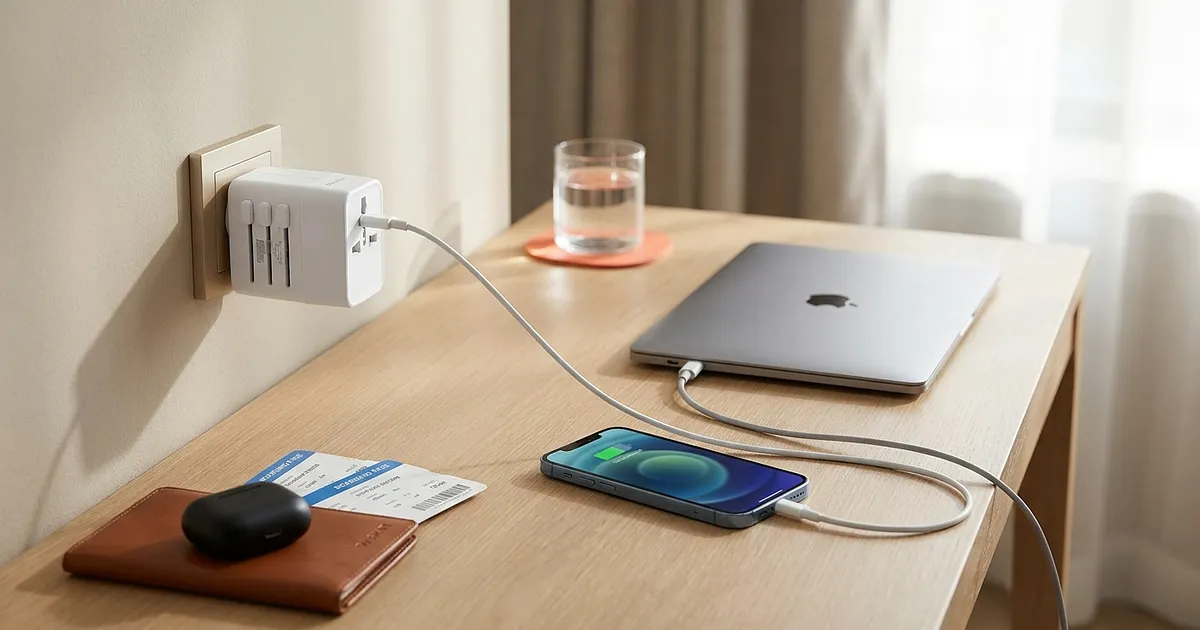
A cheap travel adapter off an online marketplace looks like every other one. It fits the socket, charges your phone, costs next to nothing. And that's exactly the problem. A 2026 investigation by Electrical Safety First found safety defects across all 15 adapter models it pulled from online marketplaces, from missing fuses to exposed live pins. If you travel with a phone, a laptop and a mobile hotspot, that little plug carries a lot more weight than just "does it fit."
Transparency: this post contains Amazon affiliate links. If you buy through one, we earn a small commission and your price stays the same. All prices and ratings below are researched Amazon listings (as of August 2026), not our own lab test.
The 5 travel adapters compared
I lined up five common universal adapters from Amazon, from the 12-euro classic with no USB to the 70W GaN powerhouse for laptop users. The table has the hard facts. Which adapter suits which kind of traveler comes further down.
| Model | PD watts | Ports | USB-C PD | Price (as of Aug 2026) | Rating |
|---|---|---|---|---|---|
| Anker Nano Travel Adapter Worldwide | not stated by maker | 2x USB-C, 2x USB-A, 1x AC | USB-C present, PD not specified | 24.99 € | 4.5 of 5 |
| TESSAN Travel Adapter Worldwide | not stated by maker | 2x USB-C, 2x USB-A, 1x AC | USB-C present, PD not specified | 21.99 € | 4.6 of 5 |
| MOMAX 70W GaN Travel Adapter | 70W | 3x USB-C, 2x USB-A, 1x AC | Yes, 3x USB-C PD | 38.99 € | 4.6 of 5 |
| EPICKA 45W PD Travel Plug | 45W | 3x USB-C, 2x USB-A, 1x AC | Yes, 45W PD | 30.99 € | 4.7 of 5 |
| Brennenstuhl Travel Plug Set | no USB | 7 plug inserts | No, purely mechanical | 11.99 € | 4.5 of 5 |
A quick word on honesty. For the Anker and the TESSAN, the Amazon listing doesn't state a specific PD wattage. Both have USB-C ports, but the exact charging power isn't cleanly documented. So the table says "not stated by maker" instead of a number I'd have made up. Anyone who genuinely needs full laptop charging is better off with the MOMAX or EPICKA anyway, where the wattage is right there in the product name.
What actually matters in a travel adapter
Most buying guides rank adapters by port count and price. That's not enough if you travel with real gear. For you, a different question matters: will this thing charge my phone, my hotspot and my laptop at the same time without any of them crawling?
USB-C Power Delivery: which wattage charges what
USB Power Delivery is a negotiation between the charger and the device. The two agree on a safe combination of voltage and current. What that means in practice: a phone that caps out at 20W charges no faster on a 65W charger than on a 20W one. As a test by heise online shows, a big wattage number alone doesn't guarantee fast charging. What decides the speed is how much power the device itself requests over USB-PD.
The rough rule of thumb for matching wattage to gear:
20W to 30W: smartphones, most mobile hotspots and travel routers
30W to 45W: tablets, fast-charging Android phones
45W to 70W: thin ultrabooks, handheld consoles
70W to 100W: powerful laptops with dedicated graphics
So what the high wattage buys you isn't speed for your phone. It's the ability to power several devices at once, or to charge a genuine power hog like a laptop at full speed. Treat these wattage bands as commonly cited industry rules of thumb, by the way, not lab-measured law.
Ports and charging several devices at once
A 70W adapter with a single USB-C port is nearly useless to a digital nomad. In a hotel at night you usually have exactly one free socket and three or four dead devices. Phone, laptop, hotspot, maybe earbuds or a watch on top.
That's why several USB-C ports plus an AC socket beat one high wattage number. But read the fine print: many multi-port chargers split their total power. 70W total can mean a single port drops to 30W the moment a second device is plugged in. For phone plus hotspot that's plenty. For laptop plus phone at the same time it gets tight if the laptop wants 65W.
Fuses and protection: the 2026 test findings
Now the uncomfortable part. As ITV News reported in July 2026, one dangerous adapter model had sold more than 50,000 times worldwide before it failed testing outright. Exposed live pins, no fuse, no shock protection. Another product even carried the "Amazon's Choice" badge and was marketed as "shockproof," yet had no safety shutters at all.
So what does that mean for your purchase? A marketplace badge and a marketing promise are not a safety certificate. What you should actually check:
CE marking stamped on the casing itself, not just in the listing text
a visible fuse or a replaceable fuse cartridge
safety shutters in the socket openings, so no bare contacts are reachable
a cleanly built housing with no wobbly pins or gaps
Giuseppe Capanna, Product Safety Engineer at Electrical Safety First, sums it up well: what looks like a bargain can end up costing a lot more. On an adapter that hangs off your laptop brick next to your hotel bed, that's not a detail you wave away.
Grounded or ungrounded: the earth pin
Not every adapter carries the earth connection through. And that matters more than it sounds. Laptop bricks, plenty of cameras and anything with a metal body often use a grounded three-pin plug.
Here's an example that makes it concrete. Every UK Type G plug carries its own fuse inside the plug, colour-coded (3 A for chargers and small electronics, 13 A for kettles and heating appliances). You can read the detail on Wikipedia. A cheap universal adapter missing that very fuse isn't a cosmetic difference, it's a real fire risk. If you're carrying a grounded device, buy an adapter that explicitly passes the earth through.
GaN: small, light, cool
GaN stands for gallium nitride, a semiconductor material replacing old-school silicon in modern chargers. The practical payoff: at the same wattage, GaN chargers get smaller, lighter and run cooler. That's exactly why a 70W charger fits in your pocket today when five years ago it would've been a brick. For carry-on travelers that's a genuine win, because one GaN adapter replaces several separate power supplies.
A travel adapter is not a voltage converter
This is the single most important paragraph in the whole piece, so read it twice. A travel adapter only changes the shape of the plug. It does not change the voltage. Full stop.
Hendrik Schäfer of the German electrical association VDE warns that high-draw devices should preferably not be run through a simple travel adapter, and that before using a device abroad without its original power supply, you have to check it's compatible with the local mains voltage.
Here's how you make the call in ten seconds. Flip your power brick over and read the label. If it says 100-240V, your device is built for the whole world and you only need a shape adapter. If it says a single voltage like 120V or 230V, you need an actual voltage converter. Almost all phones, laptops and cameras are wide-range devices today (100-240V). Hair dryers, curling irons and straighteners often aren't. And even with a converter, hauling a 230V dryer abroad is rarely worth it. Use the one in the hotel.
Plug types by region: the short version
According to World Standards, there are 15 standardised plug types worldwide, differing in grounding, voltage range and amperage. For practical purposes this extract is enough. For a full country-by-country list, see Wikipedia.
| Region / Country | Plug type | Mains voltage | Grounded? |
|---|---|---|---|
| USA, Canada, Mexico | Type A / B | 120V | partly (Type B) |
| Japan | Type A / B | 100V | partly |
| UK, Ireland, Scotland | Type G | 230V | yes |
| Europe (DE, FR, ES, NL) | Type C / F (Schuko) | 230V | yes (Type F) |
| Switzerland | Type J | 230V | yes |
| Italy | Type C / F / L | 230V | partly |
| Australia, New Zealand | Type I | 230V | yes |
| South Africa | Type M / N | 230V | yes |
| India | Type D / M | 230V | yes |
The UK (Type G) and the USA (Type A/B) are the two destinations travelers most often search a dedicated adapter for, which makes sense, they're two of the most common long-haul trips with a different socket. A good universal adapter covers both plus the rest of the list.
Flights and carry-on: what applies in 2026
Short but important aside for anyone with a lot of tech in their bag. The ADAC points out that power bank rules for flights tightened in March 2026. A maximum of two power banks up to 100Wh in carry-on, none in checked baggage, no charging mid-flight, and the batteries have to stay within reach.
What's that got to do with your adapter? The more your adapter does on its own, the fewer separate chargers and power banks you have to pack in the first place. One GaN adapter with four USB ports easily replaces three individual bricks. Fewer lumps in your backpack, less hassle at security.
Which adapter for which kind of traveler
Enough theory. Here are the concrete picks, each with the honest note on who the adapter is NOT for.
The all-rounder: Anker Nano
Anker is a safe bet in the charger world, and the Nano travel adapter is the solid default for people who just want a reliable device without thinking about it. Two USB-C, two USB-A and one AC socket cover the usual travel setup. At 24.99 € (as of August 2026) and 4.5 of 5 stars from over 2,200 reviews, you get brand quality without a premium-price headache.
Who it's NOT for: if you want to fully charge a 90W gaming laptop on the road, this isn't your adapter, it doesn't advertise the high PD output for that. Look at the MOMAX below instead.
Anker Nano Reiseadapter Weltweit (2x USB-C, 2x USB-A, 1x AC)
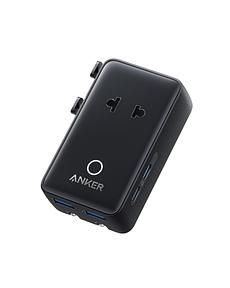
Anker Nano Reiseadapter Weltweit (2x USB-C, 2x USB-A, 1x AC)
View at AmazonAffiliate link. Buying through it earns us a commission; the price stays the same for you.
The value pick: TESSAN
TESSAN is the most-reviewed adapter in the lineup, over 7,000 reviews and 4.6 of 5 stars. For 21.99 € (as of August 2026) you get the same core kit as the Anker (two USB-C, two USB-A, one AC socket) for a few euros less. If you're watching every euro but still don't want to end up with a no-name model, that's a sensible compromise.
Who it's NOT for: here too the PD wattage isn't cleanly stated. Anyone who needs the maximum documented laptop charging power should pick a model with a clear wattage spec.
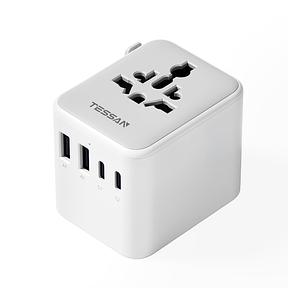
TESSAN Reiseadapter Weltweit mit 2 USB-A und 2 USB-C, Grau
View at AmazonAffiliate link. Buying through it earns us a commission; the price stays the same for you.
For laptop nomads: MOMAX 70W GaN
This is your adapter if you work remotely and genuinely need to charge your laptop on the move. 70W GaN, three USB-C ports with Power Delivery and two USB-A. That realistically charges a laptop and a phone in parallel, and thanks to GaN it stays pleasantly compact. At 38.99 € (as of August 2026) and 4.6 of 5 stars it's the priciest in the field, but the only one with real laptop headroom.
Who it's NOT for: if you travel with just a phone and earbuds, you're paying for power you'll never draw. The Anker or TESSAN does the job just as well.
MOMAX 70W GaN Reiseadapter Weltweit, 6-in-1 mit 3 USB-C PD und 2 USB-A
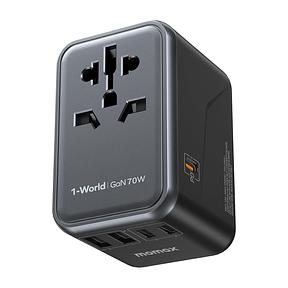
MOMAX 70W GaN Reiseadapter Weltweit, 6-in-1 mit 3 USB-C PD und 2 USB-A
View at AmazonAffiliate link. Buying through it earns us a commission; the price stays the same for you.
The middle ground: EPICKA 45W
EPICKA sits right between the budget standard and the 70W powerhouse. 45W PD, three USB-C, two USB-A, and at 4.7 of 5 stars the best rating in the whole comparison. For 30.99 € (as of August 2026) the power is enough to charge an ultrabook and keep a phone topped up alongside it. A good middle path if 70W feels like overkill and the USB-C-free option feels like too little.
Who it's NOT for: if you've got a power-hungry 15-inch work laptop that pulls 65W or more, 45W could get tight when you charge two things at once.
EPICKA Reisestecker Adapter 45W PD Fast Charge mit 3 USB-C und 2 USB-A
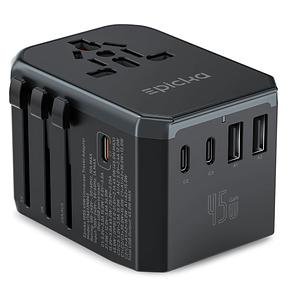
EPICKA Reisestecker Adapter 45W PD Fast Charge mit 3 USB-C und 2 USB-A
View at AmazonAffiliate link. Buying through it earns us a commission; the price stays the same for you.
The minimalist with no USB: Brennenstuhl set
Sometimes you just want the plug to fit, nothing else. The Brennenstuhl travel plug set with seven plug inserts is purely mechanical, no USB, no frills, but from a German brand with a good reputation and, at 11.99 € (as of August 2026), by far the cheapest here. Ideal as a backup in your wash bag, or for travelers who bring their own chargers anyway and only need to bridge the socket.
Who it's NOT for: for the connected traveler with a phone, laptop and hotspot, this is too little. With no USB ports you still need your own bricks, which are exactly what you might have wanted to leave at home.
Brennenstuhl Reisestecker-Set / Reiseadapter-Set (7 Steckereinsätze)
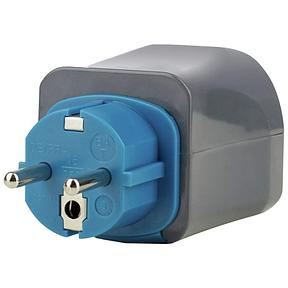
Brennenstuhl Reisestecker-Set / Reiseadapter-Set (7 Steckereinsätze)
View at AmazonAffiliate link. Buying through it earns us a commission; the price stays the same for you.
The bottom line
The best travel adapter isn't the cheapest, and it isn't the one with the most watts. It's the one that matches your device stack and is safely built. Travel light and a solid all-rounder like the Anker or the cheaper TESSAN is plenty. Work off a laptop on the road and there's barely a way around the MOMAX with its 70W. And whichever you pick: flip the brick over once, read the voltage label, and look for a CE mark, a fuse and safety shutters. Those two minutes are cheaper than a fried charger in a hotel room.
If you're planning your abroad setup anyway, the socket is only half the battle. How you get online abroad fast and cheap is what our eSIM comparisons cover, destination by destination.
All products from this post
The ones we named above are marked; the rest are alternatives in the same category.
Affiliate notice: As an Amazon Associate, we earn from qualifying purchases. Product prices and availability are subject to change.
Frequently Asked Questions
What is the difference between a travel adapter and a voltage converter?
A travel adapter only changes the shape of the plug so it fits a foreign socket. A voltage converter actually transforms the mains voltage, say from 120V to 230V. Phones, laptops and cameras usually accept 100-240V and only need the shape adapter. Only devices with a single fixed voltage, such as some hair dryers, need a real converter.
Which travel adapter do I need for the UK and the USA?
For the UK (and all of Britain) you need Type G, the three-pin British plug at 230V. For the USA and Canada it's Type A or B at 120V. A good universal travel adapter covers both plug types plus most other countries, so you don't have to buy a separate model for every destination you visit.
Can I charge my phone, laptop and hotspot at the same time?
Yes, if the adapter has enough ports and total power. Look for several USB-C ports and enough wattage, say 65W or more if a laptop is involved. Keep in mind that many multi-port chargers split their power: plug in a second device and the power per port drops. For phone plus hotspot that's almost always fine, for laptop plus phone it gets tighter.
How do I spot a safe travel adapter?
Look for a CE mark on the casing itself, a visible or replaceable fuse, and safety shutters in the openings. Marketplace badges and marketing claims like "shockproof" are not proof. A 2026 safety test found exposed live pins and missing fuses in cheap marketplace adapters. A cleanly built housing with no wobbly pins is a good sign.
Is there a Which?-style tested best travel adapter?
Not from an independent consumer lab that we could confirm as of August 2026. The common "winner" badges usually come from comparison portals rather than a genuine test lab. So lean less on badges and more on the hard features: a fuse, safety shutters, a CE mark, and the right USB-C power for your devices.