eSIM Vietnam 2026: Provider Comparison, Costs & Coverage
 19 min read
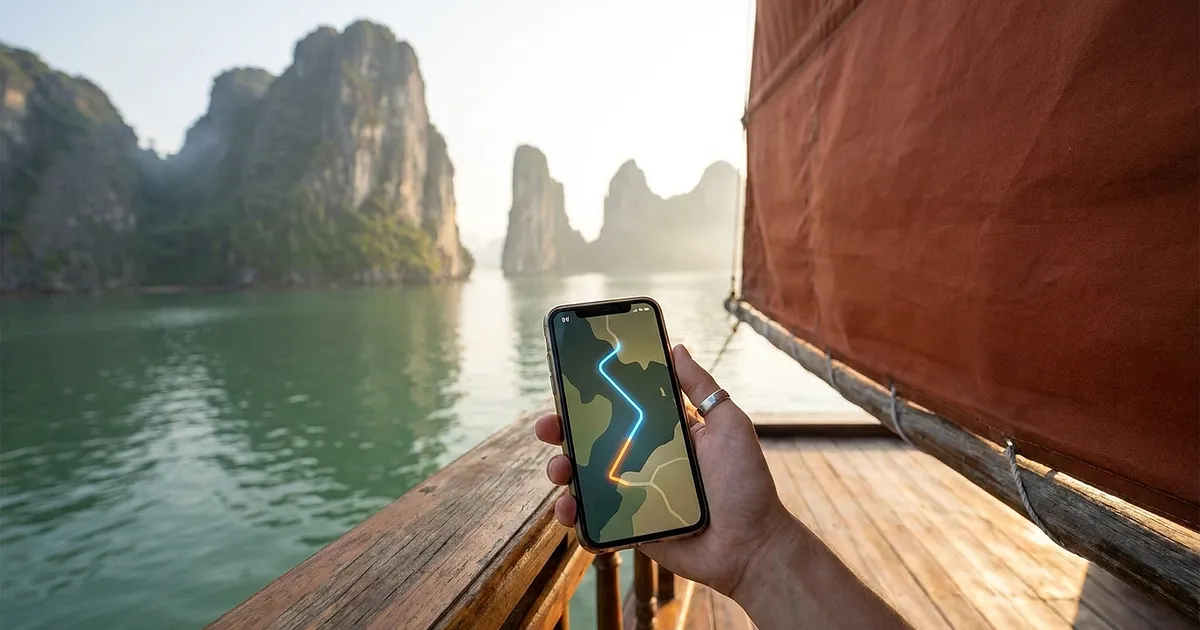
Google Maps and Grab. Those are the two apps you'll actually need mobile data for in Vietnam, and both are surprisingly light on it. Search "eSIM Vietnam" anyway and you'll mostly find shop pages pushing big bundles or straight-up "unlimited" plans. I think that's one of the more expensive planning mistakes people make. The only bigger one is leaving your home plan on roaming because switching felt like effort.
This guide covers what an eSIM for Vietnam costs in 2026, which of the country's three mobile networks still has signal once you leave Hanoi and Ho Chi Minh City, and where even the best network gives up. One thing up front: we haven't tested these plans on the ground ourselves. Everything here comes from provider information, operator data and traveler forums, and I'll tell you which is which as we go.
Do you even need an eSIM for Vietnam?
Not strictly, no. If you're mostly online at your hotel and in cafés, Wi-Fi will probably get you through, and plenty of forum posters say exactly that. The moment you want to book a Grab, find your way back through Hoi An's old town or check where your sleeper bus actually is, though, you need mobile data.
So why not just use your home plan? Unless it explicitly lists Vietnam in an included-roaming zone, you're paying a daily pass or per-MB rates. I haven't put numbers for carriers like AT&T, Verizon, EE or Vodafone in here on purpose: those rates change constantly and I couldn't verify them for September 2026. Checking your carrier's app before you fly takes two minutes. Disputing the bill afterwards takes a lot longer.
How big the gap can get shows up in a case study from GSMA Intelligence. One traveler used to pay more than £6 a day in roaming fees in Japan, switched to a travel eSIM at roughly £13 for 10 GB, and has saved around £630 across several trips since 2022. That's Japan, not Vietnam. The math works the same way, though.
The more interesting number from that same source, to me, is this one. In a survey of travelers from 11 countries, only 12% had used any eSIM abroad in the past year, and more than 70% of those used their own home carrier's eSIM roaming product.
Meanwhile Travel Daily News puts eSIM adoption among travelers at 28.1% for the 2026 summer season, up from 19.0% the year before, based on GSMA Intelligence data. Do those two figures contradict each other? I suspect they're simply measuring different things. Either way, bringing your own travel eSIM still puts you in the minority in 2026.
Local Vietnamese eSIM or international travel eSIM?
Two routes, and the difference is who you buy from. A local eSIM comes straight from a Vietnamese mobile operator. An international travel eSIM comes from a reseller like Airalo, Holafly, Saily or Gigago, which buys data from a local network and sells it on.
Viettel runs its own tourist eSIM program at Noi Bai (Hanoi), Tan Son Nhat (Ho Chi Minh City) and Da Nang airports, gohub.com reports. You're on the Viettel network directly, no middleman. The catch is that you can only buy after landing, you'll be standing at a counter, and you'll need your passport.
International providers flip that around. You install at home on Wi-Fi, and you're online the moment the plane touches down in Hanoi. Which Vietnamese network the plan actually uses is usually listed in the plan details. That's the line I'd read before buying, even before the price.
Viettel, Vinaphone or MobiFone: which network is best?
For an eSIM in Vietnam outside the big cities, go with Viettel. In Hanoi, Da Nang and Ho Chi Minh City all three networks hold up fine; the differences show up in the mountains, on the water and in the countryside.
The numbers behind that are pretty clear. Vietnam's combined 5G networks covered about 92% of the population as of July 2026, through more than 40,000 base stations, most of them not in Hanoi or Saigon but exactly where you'll actually test them as a traveler: out in the countryside. That's according to a market analysis of Vietnam's 5G rollout. Viettel alone reports 90% outdoor and 70% indoor 5G coverage.
And the lead is growing, if anything. Viettel plans to add around 20,000 stations in 2026 to reach 98% of the population, while VNPT, the group behind Vinaphone, is targeting 50 to 60% over the same period (both from the same analysis). 5G is also still new here: all three operators only launched it commercially between October 2024 and June 2025. Network comparisons from 2024 are basically out of date.
Why Viettel in particular? It started life as a military-run telecom with a mandate to build into the Northwest and the Central Highlands, as gohub.com explains in its Viettel review. In other words, towers in places a purely commercial operator would never have bothered with. Roughly half of all mobile subscribers in Vietnam are on Viettel, per esimy.net.
MobiFone comes up less often in traveler forums, usually as a solid city option. I couldn't find a current, reliable coverage figure for MobiFone, so there isn't one here.
Honestly, "best network" still depends on your route. If you're only doing Hanoi, Hoi An, Da Nang and Saigon, I wouldn't pay extra for a Viettel eSIM in Vietnam. Add Sapa or an overnight cruise in Ha Long Bay and I would.
eSIM Vietnam compared: the providers in 2026
A quick note on prices first. Travel eSIM pricing can change week to week, and for several providers I couldn't pin down a verifiable Vietnam price for September 2026. So instead of guessing, the table below shows how the providers actually differ. The prices I could source are in the cost calculator further down.
| Provider | Type | Network in Vietnam | Is "unlimited" throttled? | Good fit for | Not ideal for |
|---|---|---|---|---|---|
| Viettel tourist eSIM | local, direct from the operator | Viettel | depends on the package, ask at the counter | long trips, the north, mountains | anyone who wants to be online the second they land |
| Airalo | international reseller | see plan details | yes, daily fair-use cap | short trips, light users | anyone expecting rock-solid service (forum reports are mixed) |
| Holafly | international reseller | see plan details | close to unthrottled, per our research | heavy social media, people who don't want to count | anyone who uses very little data |
| Saily | international reseller | see plan details | yes, daily fair-use cap | average users who like managing things in an app | anyone who wants unthrottled streaming |
| Gigago | international reseller | see plan details | n/a | Grab and translation apps (one positive forum report) | anyone who wants lots of independent reviews |
As of September 2026. Network, throttling threshold and hotspot rules are in each provider's plan terms. They change, so check before you buy.
Going direct with Viettel makes sense if you're pulling out dong at the airport and ordering a Grab anyway. No middleman, but you'll be queuing at a counter after a long-haul flight.
With Airalo, probably the best-known name, experiences in TripAdvisor's Vietnam forums are mixed. One traveler reports solid signal all the way from Hanoi to Phú Quốc and easy top-ups; another describes a flaky connection on a more recent purchase. Two voices aren't statistics. But it does show the brand name alone doesn't guarantee much.
Holafly? That's the one for people who don't want to count megabytes. From our research, Holafly's unlimited plans are among the few that get close to genuinely unthrottled speeds. You'll likely pay for that comfort with a higher daily price, so compare the current Vietnam rate on their site.
Saily is owned by Nord Security, the company behind NordVPN, and runs entirely through an app. Fixed data packs, plus unlimited plans with a daily throttling cap.
As for Gigago, I found very little independent coverage. One traveler who bought a Gigago eSIM through a visa agency wrote on TripAdvisor that it worked perfectly for Google Translate and Grab for the whole trip. Nice to hear. Still just one report.
How much does an eSIM for Vietnam cost?
For two weeks of normal use, a pre-booked eSIM runs roughly US$8 to US$18 (as of September 2026). A physical tourist SIM from the airport is often cheaper per GB. Whether it's worth the hassle is a different question.
Prices here come from provider and retailer information and are listed in US dollars because that's how the sources quote them. The physical SIM price range comes from Saily's overview of SIM card prices in Vietnam, and Saily sells eSIMs itself, so read those numbers with a small asterisk.
| Scenario | Data needed (rule of thumb) | Pre-booked eSIM | Physical SIM at the airport | Price per GB |
|---|---|---|---|---|
| Layover or weekend | under 1 GB | approx. US$4.00 (Airalo, 1 GB, 3 days) | hardly worth it | eSIM approx. US$4.00 |
| 1-week city trip: Maps, Grab, messaging | 2 to 3 GB | approx. US$10.50 (Airalo, 5 GB, 30 days) | approx. US$6 to 13 (10 to 30 GB) | eSIM approx. US$2.10, SIM approx. US$0.43 to 0.60 |
| 2 weeks north to south, normal use | 5 to 10 GB | approx. US$8 to 18 (5 to 10 GB, 7 to 14 days) | approx. US$6 to 13 | eSIM approx. US$0.80 to 3.60 |
| 3 to 4 weeks, heavy social media | 20 GB or more | unlimited plan, check current price | approx. US$13 for 30 GB | SIM approx. US$0.43 |
All prices as of September 2026, indicative figures from provider and retailer information. Check the provider's own page before buying.
Per GB, the physical SIM beats the eSIM almost every time. You just pay for it in time instead, more on that below.
And the absolute amounts are small. According to cellesim.com, average spend on a travel eSIM in 2025 was still under US$15 per trip. The global market behind that hit US$3.3 billion in 2025, roughly 165% bigger than in 2023. At US$8 to 18 for two weeks, Vietnam sits right in the normal range.
What about roaming? Take the £6 a day from the GSMA example and stretch it over two weeks: £84. That's purely a thought experiment, it was a Japan rate, and your own plan might be cheaper or pricier. Even the most expensive eSIM row in the table doesn't come close, though.
How much data do you need for your eSIM in Vietnam?
Less than most people think. Navigation and Grab bookings barely touch your allowance; autoplay video is what eats it.
| Activity | Rough usage |
|---|---|
| Google Maps navigation | 3 to 5 MB per hour |
| Grab, one booking | 3 to 5 MB per ride |
| Instagram or TikTok with autoplay | 0.5 to 0.8 GB per hour |
| WhatsApp messages with photos | low, no reliable figure found |
Indicative figures as of September 2026. Real usage depends on image quality and app settings.
Run the numbers. Three hours of navigation a day for two weeks: about 210 MB. One hour of TikTok every evening for the same two weeks: up to 11.2 GB. So it's the scrolling in your hostel bed that blows through a 10 GB plan, not the route from Hanoi to Hoi An.
If you'd rather run your own numbers than trust a Vietnam-specific rule of thumb, the same math applies to any eSIM for Vietnam trip: track your heaviest daily habit (usually video), multiply by the days you'll actually have it running, and add a buffer.
My rough rule of thumb for two weeks:
Light use (Maps, Grab, messaging, the odd search): 3 to 5 GB
If you also upload photos and open Instagram now and then, you're more likely looking at 5 to 10 GB.
Lots of Reels and Stories? 15 GB and up, or just go unlimited.
Working remotely with a laptop on your hotspot: unlimited, but read the plan's hotspot rules first, since they can be restricted.
One free tip: download offline areas in Google Maps before you head to Sapa or Ha Long Bay. The section after next explains why.
What if you run out of data?
With most reseller eSIMs you just buy a top-up in the app without installing a new eSIM, as long as you've got a little data left or some Wi-Fi to finish the purchase.
Does the eSIM work in Ha Long Bay, Sapa, Phú Quốc and Phong Nha?
Traveler experience with eSIM in Vietnam is mixed by region: in the towns themselves, mostly yes. In between, not everywhere. A coverage guide from esimy.net names the problem spots pretty specifically, and they line up with what travelers report in forums.
Ha Long Bay: According to esimy.net, signal drops noticeably once boats leave the pier and head into open water. Treat the cruise as offline time. If you need to work on an overnight boat, that's a problem no unlimited plan will fix.
Sapa town itself has usable coverage per the same source, but it thins out above the town. On trekking routes above roughly 1,500 meters there are genuine dead zones. That's exactly what the offline maps are for.
Phong Nha is quick: no signal at all inside the caves, only basic coverage back in town (esimy.net). Then again, if you're looking at your phone instead of the ceiling in Paradise Cave, you're doing it wrong.
For Phú Quốc there's no reliable coverage map, just forum reports. In the TripAdvisor forums one traveler says their Airalo eSIM worked reliably from Hanoi all the way to the island, and several threads specifically recommend Viettel-based plans for Phú Quốc, Ha Long Bay and Sapa. That fits the network numbers above, but it isn't a measurement.
eSIM or a physical SIM card at the airport?
On price the two are close these days, and per GB the physical SIM is often cheaper. The real difference is time. Plus the question of whether you need a Vietnamese phone number.
To get a physical SIM in Vietnam you show your passport and register, including biometric capture. That happens at a counter in arrivals, after your flight, often in a queue. And those queues probably aren't getting shorter: Vietnam recorded around 15.9 million international arrivals in the first eight months of 2026, up 14.4% year on year, according to Trading Economics. With an eSIM from an international provider, that on-site registration simply doesn't happen.
| Physical SIM at the airport | Pre-booked eSIM | |
|---|---|---|
| Price per GB (as of 09/2026) | approx. US$0.43 to 0.60 | approx. US$0.80 to 3.60 |
| When are you online? | after registering at the counter | right after landing |
| Registration | passport and biometric capture on site | online with the provider, nothing on site |
| Vietnamese number | usually yes | usually no, data only |
| Phone requirement | a free SIM slot | eSIM-capable and carrier-unlocked |
The missing number sounds like a minor thing. Usually it is. It's just that guesthouses and tour guides in Vietnam often message you on Zalo rather than WhatsApp, since Zalo is everywhere there. As far as I know you can set it up with your home number too. A small detour, nothing more.
My take on an eSIM for Vietnam: for trips up to about three weeks I'd go with it. The few extra dollars are worth skipping the counter, especially after an overnight flight. If you're staying longer and using a lot of data, a Vietnam SIM card or Viettel's tourist offer starts to make more sense. And if your phone is older or carrier-locked, the choice is made for you anyway.
Unlimited or a fixed data plan?
"Unlimited" on almost every eSIM for Vietnam means unlimited, but throttled. Once you pass a daily cap, usually somewhere between 3 and 10 GB (as of September 2026), you keep going at a much slower speed. Holafly, as mentioned above, remains the exception with close to unthrottled plans.
Do you need it? Probably not. With the usage figures above, Maps, Grab and messaging won't get you anywhere near 3 GB a day. Unlimited makes sense if you upload video daily, stream in the evenings or keep a laptop on your hotspot. For everyone else, a fixed plan plus a top-up if needed is the cheaper deal, and you're not paying for data you'll never touch.
The word itself bugs me on shop pages. "Unlimited" there is more marketing than plan description, and the fine print with the actual throttling cap is often three clicks deep.
Is your phone eSIM-compatible? Setting it up before you leave
Setting up an eSIM for Vietnam travel is simple once you know the steps. Most iPhones from the XS and XR onward and plenty of newer Android phones support eSIM. To check yours, dial *#06#: if an EID shows up, the phone can take an eSIM. It also needs to be carrier-unlocked.
Here's how it usually goes:
- A few days before you fly, buy the eSIM and install it by QR code or app, ideally at home on Wi-Fi. With many providers the validity period only starts when you first connect in Vietnam, with some it starts on installation. It's in the terms, and I'd read them.
- Rename the eSIM in your settings, something like "Vietnam". Sounds trivial, but it saves you guessing between "Secondary" and "Travel" on the plane.
- After landing in Vietnam, switch mobile data to the eSIM and turn on data roaming for it. That confuses a lot of people, but it's normal for international travel eSIMs, which technically run over a partner network.
- Your home SIM stays on, just with data roaming switched off. That way your bank's verification texts and other 2FA codes still arrive without any data going over your home plan.
Nothing working after you land? Toggle airplane mode on and off, then pick a network manually in your network settings, which in Vietnam means Viettel, Vinaphone or MobiFone. From what support forums suggest, that fixes most first-connection problems.
Which eSIM I'd pick for Vietnam
The best eSIM for Vietnam really depends on your route. For the classic two-week route from Hanoi via Ha Long Bay and Hoi An down to Saigon: a pre-installed eSIM with 10 GB that runs on Viettel. That's plenty, and if it isn't, there's always a top-up.
Trekking in Sapa doesn't change much about the plan. Offline maps matter more there than the provider.
Four weeks or longer, with lots of Instagram? Then I'd grab the physical SIM or Viettel's tourist package at the airport and live with the wait. Holafly only if you really don't want to think about data and the higher price doesn't bother you.
Whichever provider you choose, read the line that says which network the plan runs on before you pay. In Vietnam it tells you more than the brand name does. And if you fly home with a few GB left over, that wasn't a bad buy. That's Vietnam, where the Wi-Fi password seems to be taped to every other café wall, and where an eSIM for Vietnam still pays off once you're out and about.
Frequently Asked Questions
Does an eSIM work everywhere in Vietnam?
In cities and tourist areas, generally yes. There are real dead zones though, for example on open water in Ha Long Bay, on trekking routes above Sapa and inside the caves at Phong Nha. A plan on the Viettel network gives you the best odds outside the big cities. Download offline maps before you go anyway.
Which network is best for tourists in Vietnam?
Viettel, as soon as your route goes beyond Hanoi, Da Nang and Ho Chi Minh City. The operator reports 90% outdoor 5G coverage (as of July 2026) and, thanks to its history as a military telecom, has the densest rural network. In the big cities Vinaphone and MobiFone work well too.
How much does an eSIM for Vietnam cost for two weeks?
For 5 to 10 GB, a pre-booked eSIM costs roughly US$8 to US$18 (as of September 2026). A physical tourist SIM at the airport costs about US$6 to US$13 for 10 to 30 GB, but requires passport registration on site. Prices change often, so check current rates before buying.
Do I need an unlimited eSIM in Vietnam?
Usually not. With Google Maps, Grab and messaging apps, most travelers get by on 5 to 10 GB for two weeks. Many unlimited plans also throttle after 3 to 10 GB a day (as of September 2026). Unlimited mainly makes sense for heavy social media use or laptop work over a hotspot.
Can I install the eSIM before I leave home?
Yes, and it's the easiest way to do it. Install it a few days before your flight on your home Wi-Fi using the QR code or the provider's app. With many providers the validity only starts when you first connect in Vietnam, but check the plan terms. After landing, switch your mobile data to the eSIM.
Do I get a Vietnamese phone number with a Vietnam eSIM?
With international travel eSIMs like Airalo, Holafly, Saily or Gigago, usually not, since they're data-only plans. Calls and chats then go through WhatsApp or Zalo. If you need a local number, get a physical SIM at the airport and ask for one specifically when you buy.
Sources
- GSMA Intelligence gsmaintelligence.com
- Travel Daily News traveldailynews.com
- gohub.com gohub.com
- market analysis of Vietnam's 5G rollout marketresearchvietnam.com
- esimy.net esimy.net
- TripAdvisor's Vietnam forums tripadvisor.com
- Saily's overview of SIM card prices in Vietnam saily.com
- cellesim.com cellesim.com
- Trading Economics tradingeconomics.com