Best eSIM for Greece: Provider Comparison for Island Holidays 2026
 14 min read
The honest answer to "which is the best eSIM for Greece" starts with a question back at you: do you need one at all? Greece is in the EU, so if your phone plan comes from an EU or EEA country, it already roams there at home rates, and two weeks of beach plus a few photos in the evening usually fits inside that.
But some travellers really do need their own line. And for those people the deciding factor isn't the price per GB. It's a question almost no comparison article answers: which Greek network is actually behind the eSIM you're about to buy?
On Santorini that doesn't matter. On Anafi it does.
One thing up front, because it changes how you should read everything below. We didn't measure any of this ourselves. What follows is Opensignal's testing, the carriers' own published figures, EU regulation, and prices that were live on the product pages on 3 September 2026. Where a figure is missing, I've left it missing rather than guessed.
Do you actually need an eSIM for Greece?
According to the European Parliament, the "Roam Like at Home" rule for travel within the EU has been extended until at least 2032, and Greece, as an EU member, is fully covered. So a German, French, Dutch or Irish plan works on Crete the same way it works at home, at no extra cost.
Even teltarif.de, one of Germany's big telecom news portals, tells its readers exactly that: for a normal holiday, an extra eSIM usually isn't necessary. That's a site with nothing to sell you, saying the same thing we're saying. Worth keeping in mind whenever a comparison page rushes you toward checkout.
The catch sits in the fair use clause. Under EU Roaming Regulation (EU) 2022/612, the permitted wholesale price for data roaming is falling in stages, from €2.00/GB in 2022 to €1.10/GB in 2026 and €1.00/GB from 2027. At the same time, carriers may still apply a fair use volume limit for very heavy users and charge a regulated surcharge above it. That limit isn't a single round number. It comes out of a formula tied to what you pay at home, so your contract paperwork is the only place with your real figure.
And if your plan comes from outside the EU, none of the above applies to you. UK plans have been a mixed bag since Brexit, with several carriers reintroducing daily EU roaming fees. US, Canadian, Australian and most other non-EU plans charge international rates that make even a pricey travel eSIM look cheap. For those travellers the answer is basically always yes, buy one.
Who genuinely benefits from a Greece eSIM
Heavy data users. Streaming, video calls, or tethering a laptop off your phone will hit a fair use ceiling faster than you'd think.
Planning a workation or a longer stay? Somewhere past four weeks in a row, EU roaming gets awkward in a lot of contracts. Some carriers throttle. Others send a politely worded email.
Prepaid and budget plans. Not every cheap tariff includes generous roaming, and a few exclude it almost entirely.
Got a company phone? Corporate SIMs with capped or blocked international data are the classic case.
Anyone travelling from outside the EU or EEA. No Roam Like at Home, no free ride.
Trips with a non-EU leg. From Rhodes or Kos, a day trip to Turkey is a short hop. EU roaming stops at that border, and near the eastern islands your phone can latch onto a Turkish network on its own if you let it.
Not in any of those groups? Then keep your money. How an eSIM works, and how the QR code activation goes, is covered properly in our beginner's guide to using an eSIM abroad. This piece is about what comes after that: which network, which island, which price.
How good is mobile coverage on the Greek islands?
Greece has around 6,000 islands and islets, according to Visit Greece, the official Greek National Tourism Organisation, but only about 227 of them are inhabited. No surprise, then, that network coverage varies so much from island to island.
"Larger islands like Crete, Rhodes, and Corfu behave almost like small countries, while smaller islands such as Koufonisia, Anafi, or Sikinos can feel much more tower-dependent," notes travel-eSIM guide Unusual Nomad. That observation turns into a workable three-tier split.
| Tier | Example islands | What to expect | Safest network |
|---|---|---|---|
| 1 | Crete, Rhodes, Kos, Corfu, Santorini, Mykonos | 4G nearly everywhere, 5G in towns and resorts | any of the three is fine |
| 2 | Naxos, Paros, Zakynthos, Milos, Sifnos, Lefkada | solid in the main town and port, thinner inland | Cosmote has the edge |
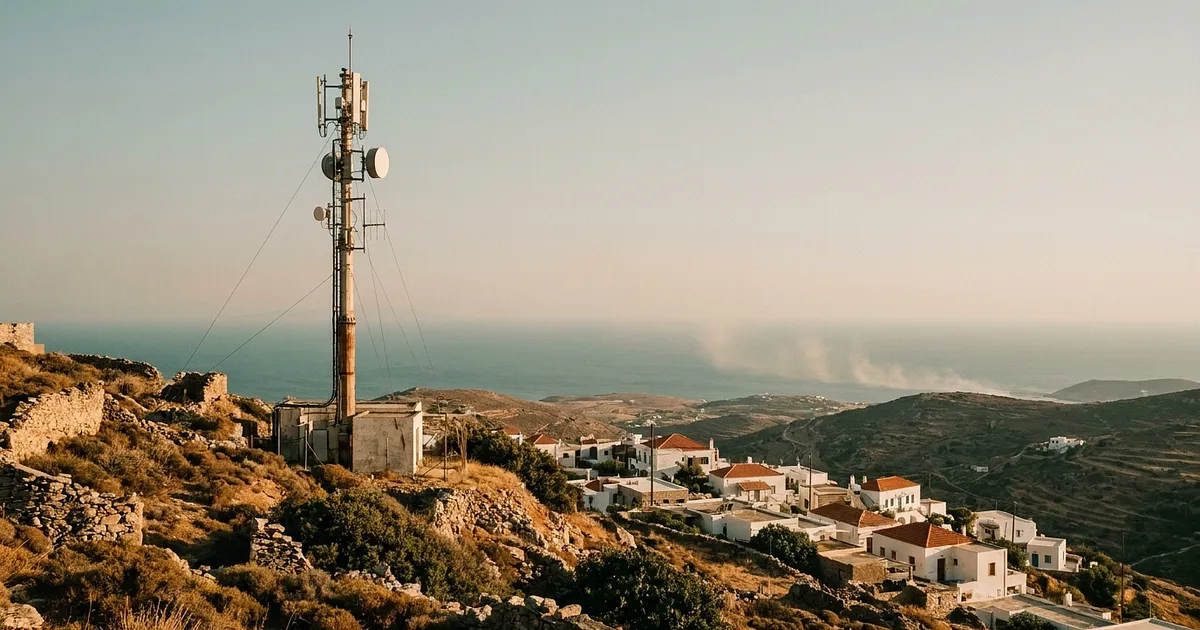
| 3 | Anafi, Sikinos, Koufonisia, Folegandros, Symi, Kastellorizo | heavily tower-dependent, dead spots are normal | Cosmote, and check first |
Why those particular islands sit in tier 1 has less to do with fame than with population density. Naxos has the best coverage in the Cyclades mostly because it's the biggest island in the group. Mykonos is far more famous, and fame doesn't build masts.
You can see how tightly visitors cluster into a handful of island groups in the 2025 arrival figures. Crete recorded 5 million arrivals, up 4.6%, the Dodecanese 4.1 million, up 2.2%, and the Ionian Islands 3.7 million, up 4.7%, according to GTP Headlines. Where the tourists go, the network build-out follows. That's half the explanation for tier 1 right there.
The dead zones no eSIM can fix
Now the part provider pages tend to skip. Even Crete, a tier 1 island with consistently good reception, has dead zones: according to Esimy, the Samaria Gorge has zero mobile coverage across its full ~16 km length, and inter-island ferries also lose signal at times. The same source puts a rough 30 to 60% of a crossing without a stable connection.
No eSIM on earth changes that. Anyone hiking or taking ferries gets furthest with the boring fix: maps saved offline, tickets screenshotted, a meeting point agreed in advance, and somebody at home who roughly knows when you're due back. That isn't a product problem, it's physics, and a physical SIM would hit the exact same wall. If you're still weighing eSIM against a physical card, we've written up the fuller eSIM versus physical SIM comparison.
Which network is behind each eSIM provider?
Greece has exactly three real mobile networks: Cosmote, part of market leader OTE, plus Vodafone Greece and Nova, the latter formed by the 2023 Wind Hellas and Nova merger. Every travel eSIM brand buys capacity from one or more of those three. None of them owns a single mast.
Vodafone Greece has expanded its 5G network to 247 cities and 70 islands, reaching over 94% of the population, according to Telecompaper, with a stated target of 96% by March 2026. That's strong. Yet in the independent Opensignal testing window of October to December 2025, Cosmote still came out ahead on coverage, scoring 8.4 out of 10 for Coverage Experience and 63.2 Mbps on download speed against Vodafone's 41.5 Mbps. Those figures come from Capital.gr reporting on the Opensignal report.
Translated into holiday terms: in Athens or on Rhodes you'll barely notice the difference. On a tier 3 island it's the whole ballgame.
So can you look up which network a provider uses? Sometimes, yes. A quick look at the product page tells the story: Airalo's Greece eSIM runs primarily on Nova's network, the Greek carrier with the smallest island footprint of the three majors. It's stated publicly. It just doesn't make it into the comparison articles.
| Provider | Greek network | Basis |
|---|---|---|
| Airalo | Nova, plus one other option | product page airalo.com, as of 2026-09-03 |
| Roafly | Vodafone Greece and Nova | provider statement, as of 2026-09-03 |
| Ubigi | Nova | provider statement, as of 2026-09-03 |
| Holafly | several networks, none named individually | provider statement, as of 2026-09-03 |
| Saily | Cosmote | provider statement, not independently confirmed, as of 2026-09-03 |
| Simbye | not stated | network not publicly named by the provider, as of 2026-09-03 |
| eSIM FOX | not stated | network not publicly named by the provider, as of 2026-09-03 |
Two rows in that table are deliberately empty. Neither Simbye nor eSIM FOX publicly names which Greek network carries its data, at least not anywhere I could find it on 3 September 2026. If your island is the deciding factor, a quick question to their support before you buy is worth the two minutes. Guessing would be dishonest, and we haven't guessed.
Everything except the Airalo row comes from the providers' own statements and hasn't been independently verified. Network partners also change, sometimes without an announcement. I'd read the product page before paying. Takes thirty seconds.
What does mobile data in Greece really cost?
Here's where most comparisons go wrong. They line up tariffs without giving you any yardstick for what counts as expensive. The yardstick is in the EU regulation. We've covered what's changing under the 2026 EU roaming rules in full elsewhere: the regulated wholesale price sits at €1.10/GB in 2026 and drops to €1.00/GB from 2027. That's not your retail price, but it is the floor you can hold every offer up against.
My personal rule of thumb, and it's arguable: under roughly €3/GB a travel eSIM is fair. Over €8/GB you're paying for convenience.
Short trip: a long weekend
Three or four days, Athens plus one island. Honestly, on an EU plan, roaming covers it. For everyone else, Airalo lists a 3-day unlimited package from €10.50 on its product page, as of 2026-09-03. That works out at €3.50 per day.
Over a window that short the network question barely matters, because you'll be in tier 1 territory the whole time anyway.
Two weeks with the family
Four phones, a hotspot for the kids' tablet, fourteen days. Budget somewhere between 10 and 20 GB for the whole family if nobody streams, and quite a bit more if they do.
This is where the arithmetic pays off: total price divided by volume, held against that €1.10/GB above. Two things get buried in family-sized plans and both matter more than the headline price. First, whether tethering is allowed at all. Second, whether the data is shared or per device. A 20 GB plan that blocks tethering is useless to a family.
Staying on Crete, Rhodes or Corfu? Price decides. Got a smaller island on the itinerary? Network decides.
One eSIM for several countries
Greece trips often aren't only Greece trips. A stopover in Italy, a few days in Cyprus afterwards, home via Athens. For that shape of trip a Europe-wide plan beats a single-country eSIM, because nothing has to be switched at a border. We've broken down the best Europe-wide eSIM plans separately.
Entry pricing for that kind of package currently starts at €0.99, as of September 2026, which of course means the smallest bundle rather than anything that would cover a family fortnight.

Affiliate link. Buying through it earns us a commission; the price stays the same for you.
A month of island hopping
Four weeks, six islands, at least three ferries. This is the scenario where the network choice outranks everything else.
Airalo lists 30 days of unlimited data at €61.50, as of 2026-09-03, so €2.05 per day. Fine on price. The snag is that Airalo's Greece plan runs primarily on Nova, and Nova is precisely the network most likely to wobble on small islands. For Crete and Rhodes, no problem at all. For Amorgos or Kastellorizo I'd rather pay a few euros more and sit on Cosmote.
That's the one place where "cheapest eSIM for Greece" and "best eSIM for Greece" stop being the same product.
Unlimited eSIM plans: work out the daily rate, not the price per GB
With unlimited plans the price per GB stops meaning anything, because there's no denominator. The daily rate is the useful number, compared against what you realistically use. At €3.50 per day, unlimited only starts paying off somewhere north of 1.5 GB a day, and hardly anyone burns that much on a beach holiday.
There's a second thing buried in nearly every "unlimited" offer's small print: past a certain daily amount, you get throttled. Unlimited almost never means unlimited speed.
eSIM or a local SIM card bought in Greece?
A Greek prepaid SIM straight from Cosmote, Vodafone or Nova is the one option where you know the network for certain, because you're buying from the network. On price it's often the cheapest route, especially for longer stays.
What it costs you is time. Passport registration, a shop at your destination, usually your first holiday morning gone. And if you land on a small island on a Sunday evening, that shop is shut.
Short version: up to two weeks, the eSIM is easier. From a month on one island, the local card makes a lot of sense.
How to decide in five minutes
- Your own plan comes first. How much roaming data, and is there a fair use ceiling?
- Then the route: write the islands down and sort them into the three tiers above.
- Tier 1 only? Price decides, and the cheapest package matching your volume wins.
- Tier 2 or 3 in the mix? Network comes first, price second. Network not stated anywhere? Ask support, no answer is also an answer.
- Last, the arithmetic: price divided by volume, held against that €1.10/GB.
That's the whole method. None of those steps takes longer than a minute, and step 4 is the one that saves half your holiday.
All products from this post
The ones we named above are marked; the rest are alternatives in the same category.
Affiliate notice: As an Amazon Associate, we earn from qualifying purchases. Product prices and availability are subject to change.
Frequently Asked Questions
Do I need an eSIM for Greece if I have an EU phone plan?
Usually not. Greece is an EU member, so an EU or EEA plan works there at home rates under Roam Like at Home, extended until at least 2032. An eSIM earns its place if you use a lot of data, stay several weeks, have a prepaid plan with weak roaming, or take a day trip to Turkey, where EU roaming stops.
Does an eSIM work on the smaller Greek islands?
Yes, but the quality depends on the network behind it, not on the eSIM brand. On big islands like Crete, Rhodes or Corfu all three Greek networks perform well. On smaller ones such as Anafi, Sikinos or Kastellorizo, Cosmote is the safer pick, based on Opensignal measurements from the October to December 2025 testing window.
What is the best eSIM for Greece?
There isn't one that suits everybody. Staying on the big holiday islands? The cheapest plan with enough data will do. Heading to smaller islands? Choose by Greek network and lean toward Cosmote. If a provider won't say which network carries its data, a quick question to support beats finding out on the island.
How much data do I need for two weeks in Greece?
For maps, messaging, email and a few photos, most people get through 3 to 5 GB per person per week. Add streaming, video calls or laptop tethering and you can easily triple or quintuple that. I'd budget generously, since topping up mid-trip costs more with almost every provider than buying the bigger plan up front.
Can I use one eSIM across several Greek islands while island hopping?
Yes. A Greece eSIM works nationwide, and nothing needs switching when you change islands. What changes is reception quality, because every island is built out differently. Plan around the weakest island on your route rather than the strongest one.
Will I have signal on the ferry between islands?
Only partly. Signal drops out during inter-island crossings, roughly 30 to 60% of the route according to Esimy. Tickets, maps and addresses are better saved offline before you board. And an onboard network at sea is worth a second look, since those often run over satellite and fall outside EU roaming rules.
Sources
- European Parliament europarl.europa.eu
- teltarif.de teltarif.de
- EU Roaming Regulation (EU) 2022/612 eur-lex.europa.eu
- Visit Greece visitgreece.gr
- Unusual Nomad unusualnomad.com
- GTP Headlines news.gtp.gr
- Esimy esimy.net
- Telecompaper telecompaper.com
- Capital.gr capital.gr
- Airalo's Greece eSIM airalo.com