Thailand SIM Card Registration: What Changed and Why eSIM Is Unaffected
 6 min read
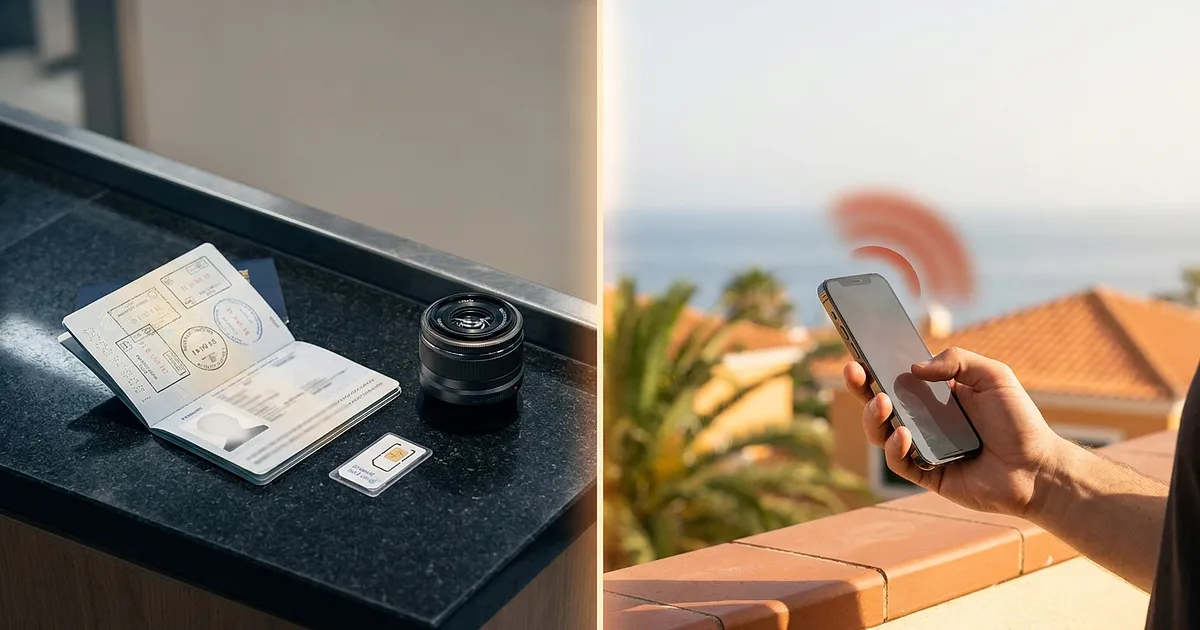
Your passport isn't enough anymore. Buy a Thailand SIM card at a counter today and you'll also spend a few seconds in front of a camera checking whether a real person is sitting there.
Short version: a physical card needs your original passport, a live photo taken on the spot, and you can hold at most three numbers per operator. A data-only eSIM from an international provider skips all of it, because it's never registered inside Thailand at all.
What actually changed at the counter
There's no clean start date, and anyone who gives you one has probably read a single source. The original notification from the regulator, the NBTC, took effect in late August 2025, and operators then had roughly 180 days to rebuild their systems. A tightened version has applied since 16 May 2026, according to LexBangkok.
Four things matter in practice:
Original passport. Photocopies aren't accepted. Staff photograph the ID page and your entry stamp.
Biometric liveness check. Blink, hold still, done. According to Biometric Update, the point is to stop registrations made with fake, edited or outdated photos.
Three numbers per operator, maximum. Developing Telecoms describes the cap as applying per network, so three at AIS and three at True. Dormant numbers count toward it.
60-day activation window. Newly registered cards have to be activated within 60 days.
None of this started with tourists. It started with call centre fraud. NBTC acting secretary general Trairat Viriyasirikul told Nation Thailand that scammers keep changing their tactics, which honestly reads like a fair description of the problem. Still a hassle at the till.
Physical SIM cards aren't banned, by the way. You'll read that a lot right now and it just isn't true. Reports on realthailandguide.com suggest the whole thing still takes a few minutes. It's mandatory and in person now, that's the difference.
Why an eSIM stays out of it
This is the part most travellers actually care about.
The rules bite where a number gets registered in Thailand: at the point of sale, with an ID document, with a photo. A data-only eSIM from Saily, Airalo, Holafly or aloSIM works nothing like that. You install it from a QR code, usually at home before you fly, it roams onto a Thai network, and it never issues you a local +66 number. No counter, no passport, no camera. reiseuhu.de describes exactly that setup.
Travelling with several devices, or as a group? It's worth weighing a mobile hotspot against an eSIM too. The registration rules don't care either way, a hotspot running on a local SIM goes through the same process as a physical card.
One honest caveat. I couldn't find an NBTC statement anywhere saying "eSIMs are exempt" in those words. What exists is rule text that consistently talks about registration at the point of sale and names the local network operators specifically. The exemption follows from that, but it isn't written down literally.
One detail is worth remembering: the eSIM type decides. If your eSIM books itself a Thai number (+66), it counts as a local SIM and runs through the same process as the plastic card. Industry watchers at Yozzo are tracking whether a stricter reading might eventually reach international providers too, though as far as they can tell there's no obligation on them today.
Physical SIM or eSIM, side by side
| Physical SIM bought locally | Data-only eSIM from abroad | |
|---|---|---|
| ID document | original passport, no photocopies | none needed in Thailand |
| Biometrics | live photo at the counter | none |
| Cap | max. 3 numbers per operator | no cap |
| Activation | in person, then a 60 day window | QR code, usually before departure |
| Local number | yes, +66 | no, data only |
All figures as of August 2026.
So what does this mean for your trip
For two weeks of Bangkok and a beach, I'd skip the counter. Not because registration is awful, but because barely any holidaymaker uses the Thai number, and data alone covers Grab, Maps and WhatsApp. If you're staying longer, or you need a local number for banking, the AIS shop still makes sense. You budget ten minutes and your passport for it. Staying longer and running several devices at once? Pairing a data-only eSIM with a portable travel router beats burning through a hotspot battery.
Which provider works out cheapest for which trip length is in our Thailand eSIM comparison. Every figure there carries a date, because prices shift monthly.
Frequently Asked Questions
Do I need a passport for an eSIM in Thailand?
Not for a data-only eSIM from an international provider. It's activated by QR code and never registered anywhere in Thailand. The passport only comes into it if you buy a physical card locally, or an eSIM that issues a Thai number.
What changed in Thailand's SIM registration rules?
Since the NBTC notification of August 2025 and the tightened version effective 16 May 2026, buying at a point of sale means an original passport, a biometric liveness check by live photo, a cap of three numbers per operator, and activation within 60 days. Photocopies are no longer accepted.
How many SIM cards can a foreigner have in Thailand?
Three per operator, so in theory three at AIS and three at True. Dormant and disconnected numbers count toward the cap. An old card from a previous holiday still occupies one of your slots.
Are physical SIM cards banned for tourists now?
No. Tourist SIMs are still sold at the airport, in AIS shops and through authorised dealers. What changed is the route to getting one: passport, photo, in person. That's a tightened process, not a ban.
Does registration apply to an eSIM with a Thai number?
Yes. As soon as an eSIM assigns you a local +66 number, the rules treat it as a local SIM and it goes through the same registration. The dividing line isn't the technology, it's whether a Thai number gets issued.