eSIM South Africa 2026: Provider Comparison & Costs for Your Safari
 19 min read
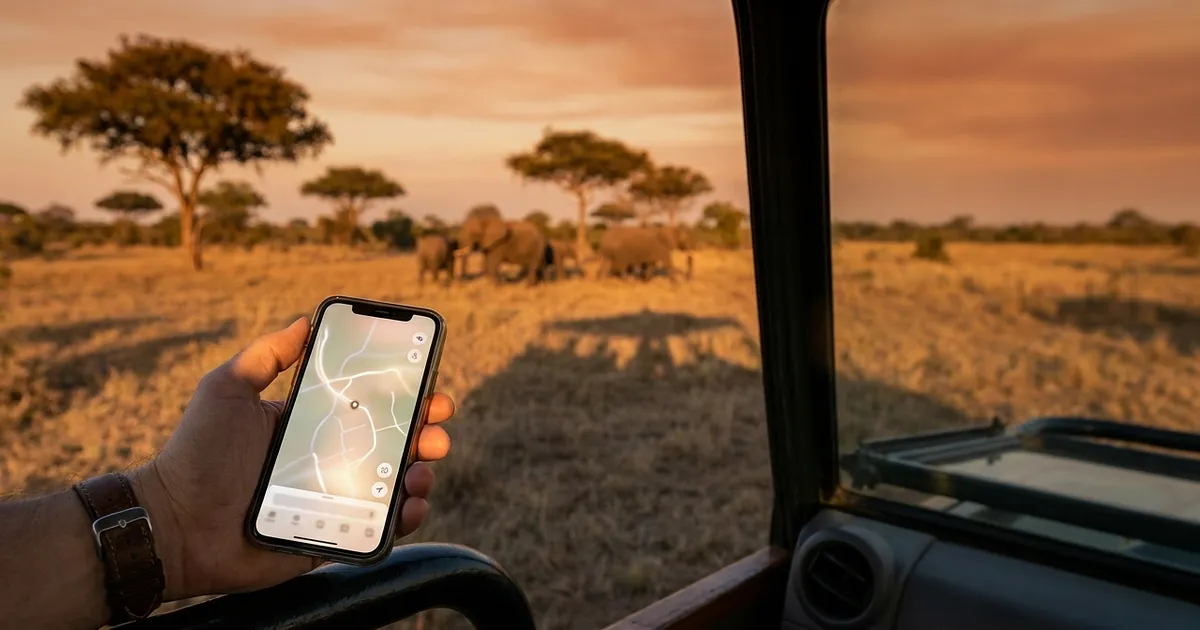
"There's no signal in the bush anyway." You'll read that line on safari forums a lot, usually as the reason an eSIM for South Africa isn't worth it. It's only half true. The safari operator Aardvark Safaris asked the camps, lodges and hotels it recommends to clients, and some 75% get a mobile signal of some kind, although about a third of those described it as patchy. So yes, you'll want an eSIM South Africa plan. Just not for the 6 a.m. game drive.
The second problem is the bill. South Africa isn't in the EU, so the free roaming you're used to in Italy or Croatia simply doesn't apply there. Fly out on your German contract with data roaming switched on and, depending on the carrier, you'll pay per-megabyte rates at which a handful of holiday photos in the family chat gets properly expensive. Further down we run the numbers for Telekom, Vodafone and o2, look at which network reaches furthest into Kruger National Park, and tell you how much data you realistically need for a city break, a safari, a road trip or remote work.
Why is roaming in South Africa so expensive?
Because South Africa sits outside the EU roaming zone. According to the European Parliament, "Roam like at Home" only covers the 27 EU member states plus Iceland, Liechtenstein and Norway. Everywhere else, your carrier's international rates kick in, and that's exactly where an eSIM South Africa plan earns its keep.
And those rates bite. The roaming overview from Holafly lists these data prices for South Africa without an add-on, and teltarif.de, a long-running German telecoms portal, confirms the price of the Telekom pack:
| Home plan | Data price without add-on | As of |
|---|---|---|
| o2 | from €1.49 per MB | September 2026 |
| Vodafone | approx. €0.14 per MB | September 2026 |
| Telekom | €0.79 per 50 KB, roughly €16 per MB | September 2026 |
| Telekom with the "Travel Mobil World" pack | €99.95 for one month, using your home plan's data allowance | September 2026 |
Sources: Holafly (per-MB prices) and teltarif.de (Travel Mobil World), as of September 2026. Your plan's roaming price list has today's rates.
In fairness, Holafly sells eSIMs itself and has an interest in roaming looking expensive. teltarif.de doesn't publish its own per-megabyte prices, but it explicitly advises checking your own terms for South Africa before you go, because they vary a lot from plan to plan. On a UK or US contract? Same logic applies, just with your carrier's own day passes and rates.
Worked example: two weeks of Cape Town plus Kruger
Our standard scenario for this guide: 14 days, half city, half safari, roughly 6 GB of data. Based on the prices above, the maths looks like this (1 GB = 1,024 MB):
| Option | Calculated cost for 6 GB |
|---|---|
| o2 without add-on (from €1.49 per MB, as of September 2026) | €9,154.56 |
| Vodafone without add-on (approx. €0.14 per MB, as of September 2026) | €860.16 |
| Telekom "Travel Mobil World" (as of September 2026) | €99.95 for one month |
| Travel eSIM with 5 to 10 GB | low to mid double-digit euro amount (provider prices, as of September 2026) |
Sure, the first two rows are theoretical. Plenty of carriers cut off your data once you hit a spending cap, long before a bill like that lands in your inbox. We still wouldn't count on it. And even if the cap kicks in, you're then standing in Johannesburg without mobile data. On o2 or Telekom without an add-on, an eSIM South Africa plan pays for itself after a few dozen megabytes.
Honestly, there's one case where the Telekom pack can be the better call: you want your German number fully reachable without a second SIM, and you'd rather not deal with installing an eSIM at all. It's convenient. It isn't cheap.
Which network is best in South Africa?
MTN leads nationally by a small margin, Vodacom is right behind, and Cell C trails far back. That's the picture from the Opensignal network comparison for South Africa, which analysed around 34,000 tests in cities, towns and on roads between May and July 2025.
| Network | Overall score (Opensignal) | Avg. download | Takeaway |
|---|---|---|---|
| MTN | 77.47 | 83.94 Mbps | best overall score, fastest downloads |
| Vodacom | 75.09 | 67.02 Mbps | close second, strong in Kruger according to Africa Unpacked |
| Telkom | 64.73 | 44.94 Mbps | mid-table |
| Rain | 64.73 | 22.13 Mbps | slowest downloads in the comparison |
| Cell C | 34.09 | 61.9 Mbps | lowest overall score by a wide margin |
Source: Opensignal via BusinessTech, test period May to July 2025.
Cell C is the interesting one. At 61.9 Mbps it downloads faster on average than Telkom, yet it finishes way behind on the overall score. Opensignal's score rolls up more than raw download speed. For you, that means speed rankings on their own won't tell you much about which network your eSIM South Africa plan should run on.
Which network will my eSIM use?
International travel eSIMs almost always run on Vodacom or MTN in South Africa. Which one your eSIM South Africa plan uses is listed in the plan details on the provider's site, usually under "network" or "supported networks". Some plans switch automatically between several. For a Cape Town-only trip it barely matters. For Kruger, if the plan gives you a choice, we'd go with Vodacom: Africa Unpacked specifically credits Vodacom with good coverage along the park's main roads and at its camps.
Why 99% coverage says nothing about the bush
According to the State of the ICT Sector Report 2025 from the regulator ICASA, 4G/LTE reaches 99.07% of South Africa's population (as of 2024). Sounds like full coverage.
But it counts people, not square kilometres, and practically nobody lives inside Kruger National Park. That figure tells you a lot about Cape Town and Durban. About the waterhole near Satara it tells you nothing.
Safari and national parks: how well does an eSIM South Africa plan work in the bush?
The network is better than its reputation, but very unevenly spread. Africa Unpacked calls South Africa's telecoms infrastructure the most advanced on the continent, and in Kruger you get surprisingly decent coverage along the tarred main roads and around the rest camps. Once your guide turns onto a side track, though, your phone is mostly just a camera. So think of your eSIM South Africa plan as a tool for evenings at camp, not for the game drive.
Kruger National Park coverage by camp
The Kruger WiFi guide from Coworking Safari breaks it down camp by camp, and the cellphone coverage map on Krugerpark.co.za shows the same pattern. The south is well covered. The centre and north have isolated pockets with big gaps in between.
| Camp | Location in the park | Signal according to Coworking Safari | What you can plan for |
|---|---|---|---|
| Skukuza | South | one of the better camps in the park | basic admin online, no critical calls |
| Lower Sabie | South | variable | messages yes, meetings not reliable |
| Pretoriuskop | Southwest | only occasional access in public areas | a quick check-in at reception |
| Satara | Centre | intermittent | don't schedule important calls |
| Olifants / Letaba | Centre to north | limited, very location-dependent | light messaging |
| Mopani / Tsendze | North | very limited | plan to be fully offline |
Need to be reachable for work? That gets tricky. According to Coworking Safari, video calls aren't reliably possible at most Kruger camps, while email and WhatsApp often work fine. For proper work days, the guide even suggests staying outside the park gates. Put important meetings on your days in the city; for the odd email, your eSIM South Africa plan will usually do the job in Skukuza.
Private reserves in Greater Kruger
Sabi Sand, Timbavati, Klaserie, Manyeleti: the private game reserves around the national park are often better connected because the lodges run their own infrastructure, and Starlink comes up more and more in safari communities. Africa Geographic names Greater Kruger as an example of mobile coverage now reaching areas that used to be off the grid.
Africa Geographic adds the caveat right away. Connections in remote areas are often slow and drop out, and some lodges deliberately skip WiFi altogether (think digital detox). If you'll depend on the lodge connection rather than your eSIM South Africa plan, it's worth asking before you book.
Addo and the Garden Route
We'll be upfront here. For Addo Elephant National Park and the lodges along the Garden Route, we didn't find coverage data anywhere near as detailed as for Kruger. The rough rule of thumb: along the main roads and in towns there's usually signal, away from them there can be gaps. Vodacom and MTN publish coverage maps on their websites. Your eSIM South Africa plan will almost always run on one of those two networks, so a quick look at the map is worth it before you book a remote lodge.
A quick detour: Botswana, Namibia, Victoria Falls
Lots of safari trips tack on a neighbouring country. In that case, a South Africa-only eSIM won't work there; you'll need a regional plan or a second eSIM. And you should lower your expectations. Aardvark Safaris ranks South Africa among the safari countries with the best coverage, and Zambia, Botswana and Namibia among the noticeably weaker ones. If you're hoping for a stable connection in the Okavango Delta, you'll probably be disappointed.
Getting your phone ready for dead zones
A few small tweaks before you leave go a long way toward getting your eSIM South Africa plan through the dead zones in the bush. And if your eSIM won't connect at all, rather than just showing a weak signal, we've collected the most common causes and fixes separately.
Download offline maps of the Kruger region, in Google Maps for example, before you leave Cape Town or Johannesburg. That way you can still find your way to the next camp where your phone shows zero bars.
Turn off automatic media downloads in WhatsApp. Otherwise a single group chat full of safari videos eats your data the moment you pick up signal at reception.
Save booking confirmations, the rental car agreement, park paperwork and your travel insurance policy as PDFs on your phone, so you can show them at the park gate or at reception even when nothing will load
Set your photo cloud backup to "WiFi only". If you shoot a few hundred pictures on a game drive, you don't want all of them uploading the second you get one bar, burning through your data before your first message even goes out.
How much data do you need for South Africa?
Less than most people expect, at least on safari. You're offline for big chunks of the day, and where there's no network you don't use anything. Cities are a different story: navigation, Uber, finding restaurants, Instagram. Our rules of thumb for an eSIM South Africa plan:
| Trip type | Length | Recommended data |
|---|---|---|
| City break in Cape Town or Johannesburg | 1 week | 3 to 5 GB |
| Safari mix (city plus Kruger or Addo) | 2 weeks | 5 to 8 GB |
| Garden Route road trip plus safari | 3 weeks | 10 to 15 GB |
| Remote work with video calls | 2 weeks or more | 20 GB or more, or unlimited |
These are estimates for typical use, not measurements. If you want more precision, here's how to calculate your own data needs for the trip. For a two-week safari round trip with navigation and WhatsApp, plus the odd photo upload, we'd expect around 3 to 5 GB of actual usage. The table still says more, because you can't top up your data in a dead zone. A buffer of a gigabyte or two is cheaper than running dry on your last evening in Skukuza.
eSIM South Africa for 30 days
For an eSIM South Africa plan covering around 30 days, it's worth looking at the bigger packages from 20 GB up, or at unlimited plans. From about four weeks on, a local prepaid SIM from Vodacom or MTN may work out cheaper too, as long as you're fine with registering it with your passport (more on that below). Run both options with current prices before you decide.
eSIM South Africa: comparing the providers
There's no clear winner here, and anyone selling you one is usually keeping quiet about the partner network. Even teltarif.de lists several options side by side for South Africa, including Airalo, Holafly, Saily, Nomad and GigSky. When you compare an eSIM South Africa plan, the plan type and the partner network matter most. Price per GB comes on top, but that changes all the time anyway.
| Plan type | Providers (selection) | A good fit if … | Probably not for you if … |
|---|---|---|---|
| Fixed GB packages for South Africa only | Saily, Airalo, Nomad, aloSIM, Ubigi, Yesim | you're doing a safari mix with predictable usage | you stream every day or work remotely |
| Africa regional package | Airalo, for example | you're adding Botswana, Namibia or Zambia | you're staying in South Africa only |
| Unlimited data with a fair-use limit | Holafly | you're spending a lot of time in Cape Town and streaming a lot | you'll be in the bush without signal for half the trip |
| Local prepaid SIM or eSIM | Vodacom, MTN | you're staying longer or need a South African number | you want to get online without queues and passport registration |
Saily, which belongs to Nord Security, sells data-only packages through its app, like most of the providers in the first row. With Nomad, aloSIM, Ubigi and Yesim the principle for South Africa is the same; price per GB and the partner network usually decide it, not the app.
Holafly is the best-known provider of unlimited data. The catch with plans like that is often a soft cap: past a certain amount of usage your speed gets throttled, and hotspot use is frequently restricted. It's all in the terms, and you'll want to have read them before paying for unlimited on a trip where you'll have no signal half the time anyway.
Airalo comes into its own on combination trips, since it offers regional packages as well as single-country ones. Tacking Botswana, Namibia or a Victoria Falls side trip onto your Kruger days? Then a regional package is usually less hassle than buying an eSIM South Africa plan first and a second eSIM for the neighbouring country later. Which countries are included is listed in the package details.
We're deliberately not listing individual prices. eSIM providers change them often, and a table of outdated euro amounts helps you less than today's price in the app. For orientation: in our research, 5 to 10 GB for South Africa came in at a low to mid double-digit euro amount (provider prices, as of September 2026).
eSIM South Africa plan or a local SIM card?
For most holidaymakers an eSIM South Africa plan is the more relaxed option. It's installed before you fly, and there's no registration to deal with on arrival. A physical SIM card still has its place, mainly for long stays or if lodges and guides need to call you on a South African number.
That's where RICA comes in. Under the Regulation of Interception of Communications Act, RICA for short, South African SIM cards have to be registered with a valid passport. That applies to cards from the local network operators, not to an eSIM from a foreign travel provider like Saily or Airalo.
Where to buy: Johannesburg and Cape Town airports or online in advance
In the arrivals halls at O.R. Tambo in Johannesburg and at Cape Town International, you'll find stores from the big network operators. They sell prepaid SIMs and handle the RICA registration on the spot. After an overnight flight from Europe, though, that means passport out, join the queue, wait. How long the queue is depends on how many long-haul flights have just landed.
An eSIM South Africa plan, on the other hand, you buy online in advance and install over your home WiFi. With many providers the validity period only starts once the eSIM connects to a network in the destination country. With some, the clock starts at installation, so it's worth a quick look at the terms.
Making calls and keeping your home number
Most travel eSIMs are data-only plans without a phone number of their own. You make calls over WhatsApp, Signal, FaceTime or Teams, which works anywhere the data connection holds up. You can leave your home SIM active alongside it, say to receive text-message codes for online banking. The one thing that matters is switching off data roaming on your home SIM. Otherwise your phone quietly pulls data over the expensive home plan in the background. We've written up the right roaming setting alongside your eSIM separately.
Is your phone eSIM-compatible?
Before you buy an eSIM South Africa plan, check two conditions. The device has to support eSIM, and it can't be carrier-locked. On iPhone that's the case from the XS and XR onwards, and the same goes for many current Samsung Galaxy and Google Pixel models. We have a separate walkthrough on setting up eSIM on Samsung and Pixel devices.
To check whether your device shows an EID on iPhone, go to Settings, General, About. If an EID shows up there, the phone can take an eSIM. And if all of this is new to you, here's how a travel eSIM actually works abroad.
Our pick for the 2026 safari season
If we had to boil it down to one line: a data-only eSIM South Africa plan with 5 to 10 GB that runs on Vodacom or MTN and is already installed before you leave home. That covers the vast majority of trips, from a long weekend in Cape Town to a round trip with three nights in Skukuza. Check the plan details for the network behind it before you buy, and you're on the safe side.
Unlimited plans like Holafly pay off if you're working in the city or streaming a lot. The Vodacom or MTN SIM at the airport, if you're staying longer than a month or need a local number. And the Telekom pack at €99.95 (as of September 2026), if convenience is worth that much to you.
And the dead zone at the waterhole? Maybe it isn't the problem everyone thinks it is. Your eSIM South Africa plan can sit that one out. Quite possibly, that hour without signal is the one you'll remember longest.
Frequently Asked Questions
What's the best eSIM for South Africa?
Which eSIM South Africa plan is best depends on your route; there's no single pick that suits every trip. For most safari trips, a data-only eSIM with 5 to 10 GB running on Vodacom or MTN is the right fit. If you'll spend a lot of time in Kruger National Park, Vodacom as the partner network usually serves you well. For heavy streaming in Cape Town, an unlimited plan like Holafly can make sense.
Will my eSIM have signal in Kruger National Park?
At the big camps in the south, like Skukuza, usually yes. Further north it thins out, and for Mopani and Tsendze you should plan to be offline. On game drives there's often no signal at all. Your eSIM South Africa plan works there just as well or badly as a local SIM, because it uses the same towers.
Can I make phone calls with a travel eSIM in South Africa?
Most travel eSIMs are data-only plans without their own phone number. You can still call over WhatsApp or FaceTime. If you need a South African number, for example so lodges or guides can call you back, a local SIM from Vodacom or MTN is the better choice.
Do I need RICA registration for an eSIM in South Africa?
Not for an eSIM from a foreign travel provider like Saily or Airalo. The RICA passport requirement applies to SIM cards from South African network operators, for example the prepaid SIM from the Vodacom or MTN store at the airport.
Does EU roaming work in South Africa?
No. "Roam like at Home" only covers the EU plus Iceland, Liechtenstein and Norway. In South Africa you pay your carrier's international rates. Without an add-on, according to Holafly, that's from €1.49 per MB on o2 and €0.79 per 50 KB, roughly €16 per MB, on Telekom, for example (as of September 2026).
How much data do I need for two weeks in South Africa?
For a safari mix of city and national park, we'd plan on 5 to 8 GB on an eSIM South Africa plan, including a buffer. On safari you use very little because you're offline a lot. In Cape Town or Johannesburg, navigation, Uber and social media take much more. If you're working remotely, budget 20 GB or an unlimited plan.
Sources
- Aardvark Safaris aardvarksafaris.com
- European Parliament europarl.europa.eu
- Holafly esim.holafly.com
- teltarif.de teltarif.de
- Opensignal network comparison for South Africa businesstech.co.za
- Africa Unpacked africaunpacked.com
- ICASA icasa.org.za
- Kruger WiFi guide from Coworking Safari coworkingsafari.com
- cellphone coverage map on Krugerpark.co.za krugerpark.co.za
- Africa Geographic africageographic.com